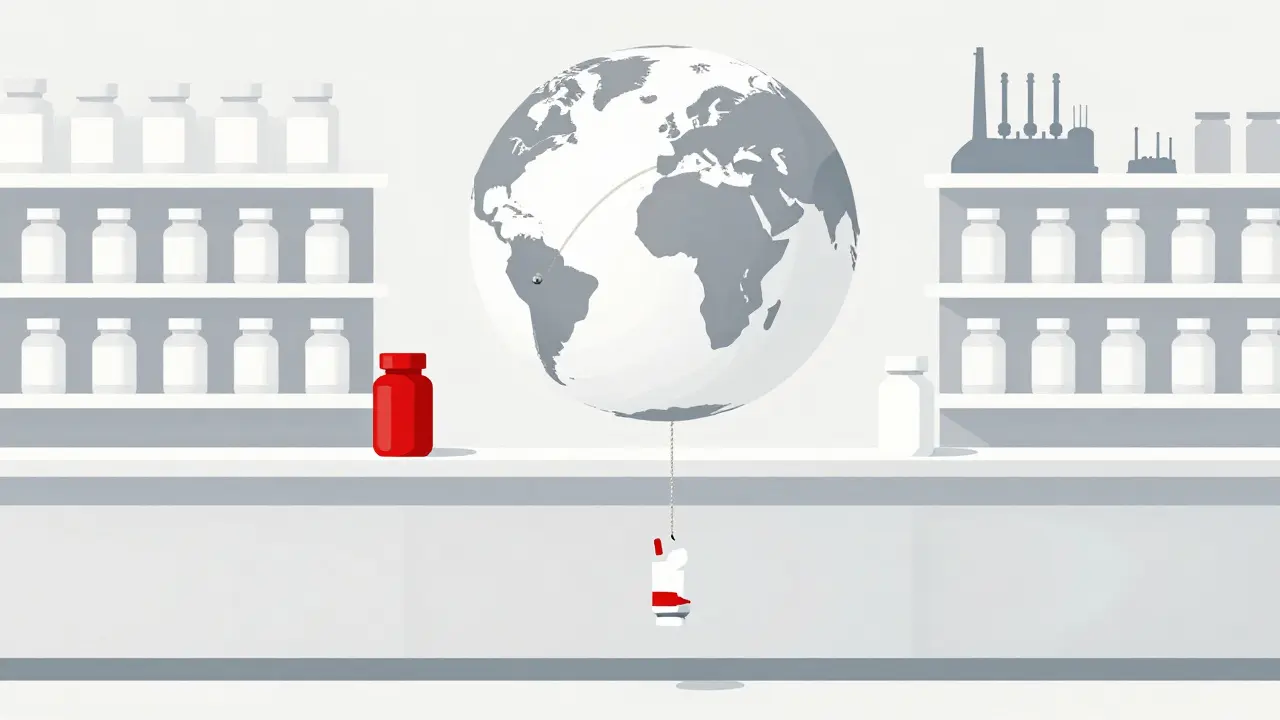


Imagine walking into your local pharmacy to refill a prescription for insulin or antibiotics, only to be told the shelf is empty. This isn't just an inconvenience anymore; it is a reality facing hospitals and clinics globally. We are standing in early 2026 looking back at a tumultuous 2025 where global connectivity became a double-edged sword. While we enjoy cheap products, our reliance on foreign manufacturing has created dangerous gaps in essential care.
Why Our Medicines Come from Abroad
To understand the shortage risk, we have to look at where the components actually come from. The core issue lies in Active Pharmaceutical Ingredients (APIs). These are the biologically active substances that make drugs work. In 2025, statistics from the National Foreign Trade Council revealed that 94% of multinational companies flagged raw material procurement as their most vulnerable segment. Why? Because the vast majority of these ingredients are produced in just two countries: China and India. They dominate roughly 80% of the global API market.
This concentration creates a single point of failure. If a port in China faces closure or a factory in India encounters labor strikes, the ripple effect hits US pharmacies months later. It is a classic case of efficiency trumping resilience. Historically, trade frameworks like the General Agreement on Tariffs and Trade (GATT) established after WWII encouraged this specialization. Companies were told to make things cheaper and faster by outsourcing production to regions with lower labor costs. For decades, this worked wonders for consumer electronics and clothing. However, for life-saving medication, this model is increasingly risky.
The Collapse of Just-In-Time Logistics
Before the global disruptions of recent years, the gold standard was "Just-In-Time" (JIT) manufacturing. The logic was simple: keep warehouse space free and order materials exactly when you need them to build the product. By late 2025, the average lead time for goods traveling from China to the United States had increased by 50% compared to 2019 levels. Suddenly, JIT wasn't saving money; it was starving hospitals.
Consider the math. A typical disruption in the Asian region could trigger a 120-day delay in delivery. For a hospital managing ICU sedatives or blood pressure medications, 120 days is catastrophic. That is why inventory management strategies shifted dramatically. Data from McKinsey shows that "just-in-case" inventory models increased stock levels by 15%. Companies realized that carrying extra stock costs less than the penalty of running out of critical drugs. While holding extra inventory ties up capital, it buys time-a commodity we suddenly found we needed desperately.
Nearshoring: The Path to Mexico and Beyond
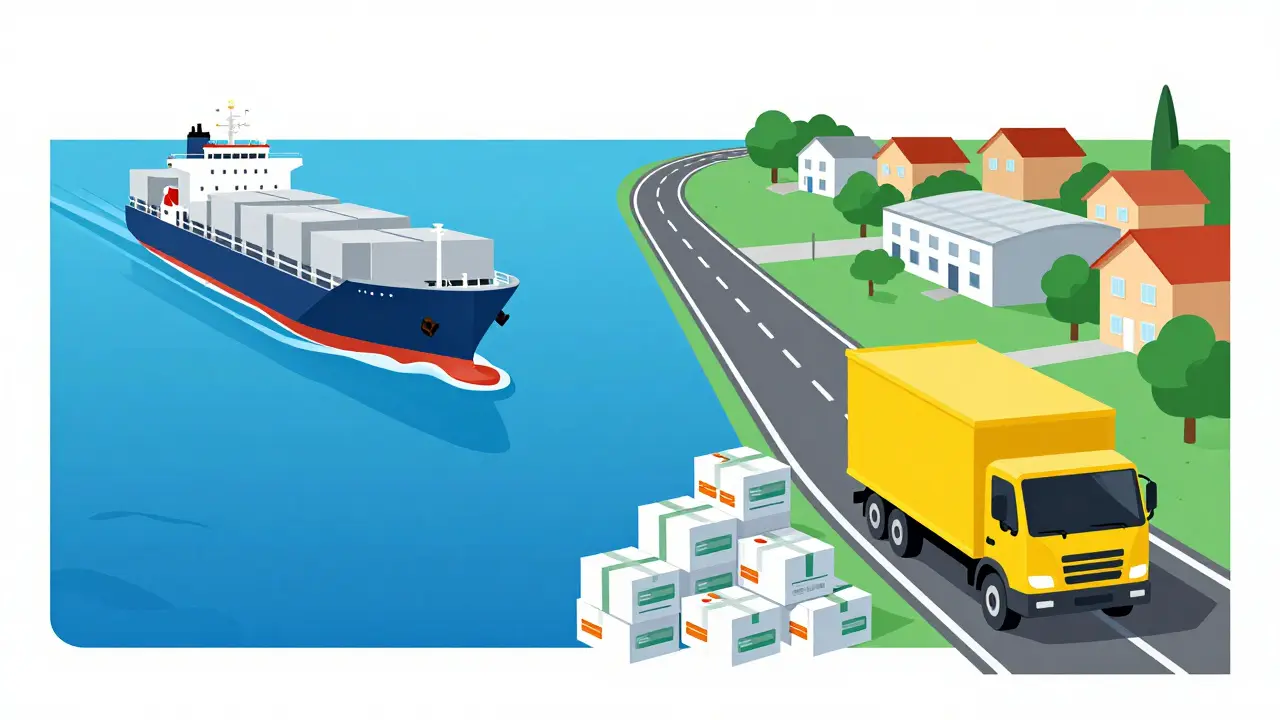
So, what happens when you stop relying entirely on Asia? Many companies are turning to nearshoring. This involves moving production closer to the final destination, often to places like Mexico. According to Plante Moran's analysis in 2025, nearshoring to Mexico offers 30-40% reduced transportation costs compared to trans-Pacific shipping. More importantly, it cuts down travel time significantly. A shipment that used to take three weeks across an ocean now takes days by truck or rail.
However, it is not without challenges. Labor investment in these nearshore locations can be 15-20% higher than in low-cost Asian hubs. Furthermore, setting up a new facility isn't instant. Transition timelines typically range from 18 to 24 months for full reshoring operations. For smaller manufacturers, this barrier is significant. It requires upfront capital and engineering support to set up factories that meet strict FDA regulations. Yet, for Fortune 500 medical device makers, the shift has proven vital. One major manufacturer achieved 99.2% on-time delivery rates after diversifying production to Mexico, documented in ASCM's Top 10 Trends Report 2025.
| Feature | Asian Manufacturing | Nearshoring (Mexico/Latin America) |
|---|---|---|
| Avg. Lead Time | 50% higher since 2019 | Reduced by transit proximity |
| Transportation Cost | High ($ per container) | 30-40% Lower |
| Labor Investment | Lower initial cost | 15-20% Higher |
| Risk Profile | Geopolitical fragility | Closer regulatory oversight |
Digital Tools and Future Resilience
Human intervention alone cannot fix global bottlenecks. That is where technology steps in. By 2025, investment in digital infrastructure like Industrial Internet of Things (IIoT) and AI became mandatory for supply chain survival. Supply & Demand Chain Executive noted that companies utilizing digital twins-virtual replicas of physical systems-can predict disruptions before they happen. E-BI’s IoT-enabled logistics demonstrated potential improvements by reducing lead times by 20% in Asia through better tracking and route optimization.
Furthermore, blockchain verification is becoming a standard requirement for quality control. Fictiv's 2025 State of Manufacturing Report indicates that ISO 28000-certified suppliers demonstrate 40% faster onboarding. Blockchain reduces quality disputes by 65%, ensuring that the batch of raw powder arriving in New York meets the same standards as the batch produced in Shanghai. This transparency is crucial for building trust with regulators and patients alike.

The Human Cost and Economic Reality
We must talk about the people involved. There is a persistent workforce shortage affecting this entire transition. Roughly 33% of companies reported understaffing in global trade management positions in 2025. You cannot rebuild complex logistical networks without skilled managers who understand compliance, tariffs, and international law. Additionally, cybersecurity remains a massive blind spot. With 60% of manufacturers reporting concerns in smart supply chains, hackers targeting pharmaceutical distribution systems pose a threat comparable to natural disasters.
Economically, there is pushback against complete localization. Professor Richard Baldwin of IMD Business School argues that total reshoring is economically unfeasible, noting that U.S. manufacturing wages remain 4.8 times higher than in China. The middle ground seems to be multi-shoring. IDC forecasts that by the end of 2026, 50% of companies will shift to balanced sourcing strategies. This hybrid approach boosts reliability by approximately 10 percentage points without forcing companies to pay exorbitant domestic price premiums for everything.
What This Means for Patient Care
Ultimately, the macroeconomic shifts translate to bedside outcomes. When logistics fail, dosage consistency drops. Patients may face treatment interruptions for conditions ranging from chronic hypertension to cancer therapies. A 2025 survey showed 56% of respondents were reducing product offerings or delaying rollouts due to these constraints. In a worst-case scenario, a 120-day disruption forces doctors to prescribe inferior alternatives, potentially compromising recovery rates.
The industry knows this. 78% of firms now use inventory buffers and supplier diversification, up from just 35% in 2020. While this stabilizes the flow, it raises operational costs. Ultimately, society absorbs some of this cost through pricing adjustments for medications. It is a trade-off we are currently weighing: paying a premium for stability versus risking empty shelves.
Frequently Asked Questions
What is causing the recent drug shortages?
Shortages are primarily caused by over-reliance on foreign manufacturing for Active Pharmaceutical Ingredients (APIs). When geopolitical tensions or logistics issues arise in key production hubs like China, delivery times spike, leaving pharmacies with empty shelves.
How does foreign manufacturing affect drug prices?
Moving manufacturing away from low-cost regions increases operational costs by roughly 20-30%. While companies try to absorb some costs, higher logistics and labor expenses eventually contribute to higher medication prices for consumers.
Is reshoring to the US feasible for all drugs?
Complete reshoring is not currently feasible for many generics due to high wage disparities (4.8x difference). Instead, companies are adopting "multi-sourcing," which splits production between Asia and nearshore partners like Mexico to balance cost and security.
What role does technology play in solving shortages?
Digital tools like AI forecasting and digital twins allow companies to predict disruptions. Blockchain improves quality verification, while IIoT reduces lead times by optimizing shipping routes.





15 Comments
It is scary how much we depend on ships. We think things just appear on shelves. But someone has to make the parts first. Shipping delays happen more now. Hospitals feel the pain the most. People get sick waiting for pills. It is bad business too. Companies lose money when stock runs low. We need a backup plan soon. This story makes sense though.
The free market solves these issues naturally. Prices go up and demand drops. Everyone complains about cost but wants safety. Efficiency was the old way. Now people want control over everything. It slows innovation down significantly. Government interference causes more problems. We should let companies decide risk.
My neighbor could not find insulin last month! It is a nightmare scenario for everyone involved. I keep thinking about my own health insurance coverage daily. A storm hitting the shipping lanes again is a possibility. The whole system feels like it is crumbling around us! We are playing with fire here. Safety is just an illusion right now. People forget how fragile modern life really is. Every single dose matters so much. I cannot sleep knowing this is real. The government needs to act immediately! This situation is worse than anyone admits publicly.
Your neighbor probably just went to the wrong store. Panic does not help anyone solve logistics issues. You sound like a movie script character writing lines. Real problems require data not fear. Stop screaming about imaginary disasters please. Your anxiety is exhausting to read honestly. Calm down and look at the actual numbers.
The concept of just-in-time inventory relies on stable geopolitical conditions. When trade routes face disruption then buffers become necessary for survival. Most corporations optimized for profit margins rather than resilience metrics historically. This shift in strategy costs capital initially but prevents total operational failure. The statistical models predict higher variance in lead times globally now. Digital twins offer a predictive edge that manual tracking lacks entirely. Blockchain verification ensures quality standards across borders without extra audits. We must recognize that efficiency cannot be the only metric anymore. Resilience requires redundancy which conflicts with pure cost reduction goals fundamentally. Society pays the price through higher medication pricing eventually. The transition period is difficult but necessary for long-term stability. Regulatory frameworks need to adapt to new nearshore realities quickly. Investment in domestic infrastructure yields lower marginal returns compared to Asia. Yet security premiums justify the expense for critical medical supplies. Technology adoption accelerates the mitigation of physical risks effectively. We are witnessing a fundamental restructuring of global economic flows currently.
You understand the core issue well.
Wow! 😲 So many changes happening all at once! 👀 I love reading these deep dives into economics 📚. It shows how connected we truly are 🌍! Some people ignore the warning signs 🚨! We need to prepare for the worst case scenarios 🔥! Don't wait until you need medicine to care 💊! Fixing supply chains helps everyone everywhere 🙏! Thanks for sharing this important info 📝! Keep fighting the good fight ✊!
They say it is about supply but it smells like something else. Someone benefits from chaos in the markets always. Big pharma moves pieces on their board carefully. Mexico suddenly matters more than before now oddly enough. Regulations change exactly when they need approval too. I see patterns others miss completely. Trust nothing coming from corporate press releases. The truth is hidden behind these nice graphs. Watch who gets paid during these transitions closely. Consequences fall on ordinary patients while executives retire. This looks planned and not accidental at all. Security gaps are features not bugs actually. Stay woke to what is really happening here.
We should bring everything back home to America immediately. Why pay foreigners to run our lives anyway? Our labor is worth more than theirs clearly. Imports create dependency we cannot afford politically. Domestic production keeps money inside our borders safely. Foreigners take advantage of our trust constantly. This policy shift protects our citizens properly. Globalism failed us during the last pandemic clearly. Protectionism saves lives when crises strike unexpectedly. Elites want cheap goods but ignore national security interests. We need strong walls around our supply chains now. American workers deserve these high wage jobs back. Weakness invites exploitation from foreign powers easily.
Nationalism ignores the reality of physics and economics. Borders mean little to molecules moving around. Philosophy suggests isolation leads to stagnation inevitably. Assertiveness without knowledge is dangerous behavior. We must accept interdependence exists regardless of feelings. Cynicism helps navigate false promises often. Truth is complex beyond simple slogans usually.
I really appreciate the effort put into analyzing these trends thoroughly. It seems clear that diversification is the key goal for stability. Many people overlook the human side of moving factories around. Workers in Mexico might gain opportunities from this shift positively. Companies investing early will likely avoid future headaches entirely. The cost increases are temporary hurdles we must climb together. Patience allows new systems to mature without breaking down. Communication between nations improves when stakes become this high. We should remember that progress takes time to materialize fully. Education helps managers understand the new rules of the game. Technology bridges gaps where physical distance used to hurt. Empathy towards patients facing shortages is crucial always. We cannot ignore the suffering caused by broken links. Support networks must strengthen alongside the logistics itself. Hope remains strong that cooperation beats competition next year. Together we can build a safer world for medicines.
That is a wonderful perspective on building community strength. I agree that patience plays a vital role in success. New opportunities emerge when old ways fail us. Energy comes from believing in positive outcomes always. We must move forward with determination and hope. Challenges create stronger systems eventually if handled right. Growth mindset helps overcome fears of change. Believe in the potential for recovery today. Future generations will thank us for acting now. Let us work harder to fix these holes.
It hurts to see how fragile systems we built over decades. I worry about friends who need daily meds constantly. Nobody talks about the stress on pharmacists enough. They stand between empty shelves and sick people daily. Empathy is missing from the political discussion mostly. We need better support for frontline healthcare staff now. Sadness turns to anger when basic needs vanish. Strong words do not fill pill bottles unfortunately. Reality hits hard when bills come due later. Silence is loud when people disappear from lists.
India produces many generic drugs for the global market responsibly. Our pharmaceutical industry follows strict quality protocols for safety. Collaboration between nations strengthens patient access significantly. We welcome partnerships that improve regulatory alignment worldwide. Understanding cultural contexts helps bridge communication gaps effectively. Respect for intellectual property supports innovation cycles properly. Developing economies benefit from fair trade practices equally. Knowledge transfer accelerates development in emerging regions too. Trust builds slowly but lasts longer than contracts alone. Mutual understanding reduces friction during crisis situations. We aim to maintain reliable output for partners globally. Dialogue remains the best tool for resolving disputes peacefully. Shared goals outweigh competing interests ultimately.
Optimism drives progress in the face of significant challenges ahead. We must remain resilient despite current obstacles appearing. Strategic planning ensures sustainable growth for all stakeholders involved. Formal analysis confirms the path forward is clear. Actionable steps yield better results than debate alone. Confidence in solutions grows with implementation speed. Success depends on unified efforts across sectors. Leadership requires vision and commitment to excellence. We shall overcome these barriers through collective strength. Perseverance defines the era of recovery and rebuilding.