



Spinal Procedure Anticoagulant Timing Calculator
How This Calculator Works
This tool calculates safe timing for spinal procedures based on medical guidelines. Enter your specific medication details to see recommended wait times before your procedure and after recovery.
Timing Recommendations
Getting an epidural or spinal injection while on blood thinners sounds simple-until something goes wrong. For most people, these procedures are routine: a needle, a bit of numbness, relief from pain or labor. But for those taking anticoagulants-warfarin, enoxaparin, rivaroxaban, apixaban, or even daily aspirin-the risk isn’t just theoretical. It’s life-altering. A single misplaced needle or a slightly delayed dose can lead to a spinal epidural hematoma (SEH), a rare but devastating condition where blood pools around the spinal cord, crushing nerves and sometimes causing permanent paralysis.
What Exactly Is a Spinal Epidural Hematoma?
A spinal epidural hematoma happens when blood collects between the dura mater (the tough outer membrane around the spinal cord) and the ligamentum flavum (a ligament in the spine). That space is tiny-less than a teaspoon in volume. So even a small amount of bleeding, as little as 1-2 mL, can create enough pressure to damage the spinal cord. Symptoms come fast: sudden midline back pain, numbness in the legs, weakness, trouble urinating or having a bowel movement. In 93% of cases, back pain is the first sign. If you don’t act within 8 hours, the chance of full recovery drops from 79% to just 9%.It’s not common-about 1 in 150,000 for a standard epidural-but it’s not rare enough to ignore. In the U.S., over 40 million spinal procedures are done every year. Even a 0.01% risk means hundreds of people could be affected annually. And when it happens, the cost isn’t just medical-it’s personal. One patient described losing control of their legs after a hip replacement. Another, a 68-year-old man on rivaroxaban, developed saddle anesthesia after his epidural catheter was removed. He needed emergency surgery. He still walks with a cane.
Which Blood Thinners Are Most Dangerous?
Not all anticoagulants are created equal. The risk depends on the drug, the dose, and how long it’s been since the last dose.- Warfarin: If your INR (a blood test that measures clotting time) is above 1.4, your risk jumps 8.7 times. Even if your INR is normal (1.0-1.2), there have been cases of hematoma. That’s why guidelines say to check your INR within 24 hours before the procedure-and never proceed if it’s over 1.4.
- Low Molecular Weight Heparin (LMWH), like Lovenox: This is one of the biggest culprits. The FDA documented 100 confirmed cases linked to Lovenox between 1992 and 2013. If you take it for blood clot prevention (prophylactic dose), you need to wait at least 10-12 hours before the procedure. If it’s a therapeutic dose (for an active clot), you need to wait 24 hours. Resume 2 hours after a single injection, 4 hours after a catheter.
- Direct Oral Anticoagulants (DOACs): These include rivaroxaban (Xarelto), apixaban (Eliquis), dabigatran, and edoxaban. They’re easier to manage than warfarin-but not risk-free. Rivaroxaban carries a 0.08% risk if stopped 48 hours before the procedure. That number jumps to 0.42% if stopped too late or too early. Apixaban is slightly safer at 0.05%. But here’s the catch: if you have kidney problems (CrCl under 30 mL/min), you need to stop these drugs 72 hours ahead.
- Antiplatelets: Aspirin alone? Risk is nearly negligible-0.03% in one study of over 1,200 patients. But if you’re on dual therapy (like aspirin + clopidogrel), your risk triples. Many anesthesiologists now recommend stopping clopidogrel for 7 days before a spinal procedure. Some don’t. That’s where the controversy starts.
Here’s the hard truth: guidelines say one thing, but real life is messier. A 2022 survey of 345 pain doctors found only 58% knew the correct timing rules. One doctor missed a patient’s rivaroxaban dose and proceeded anyway. The patient developed paralysis. The lawsuit settled for $1.4 million.
Who’s at Highest Risk?
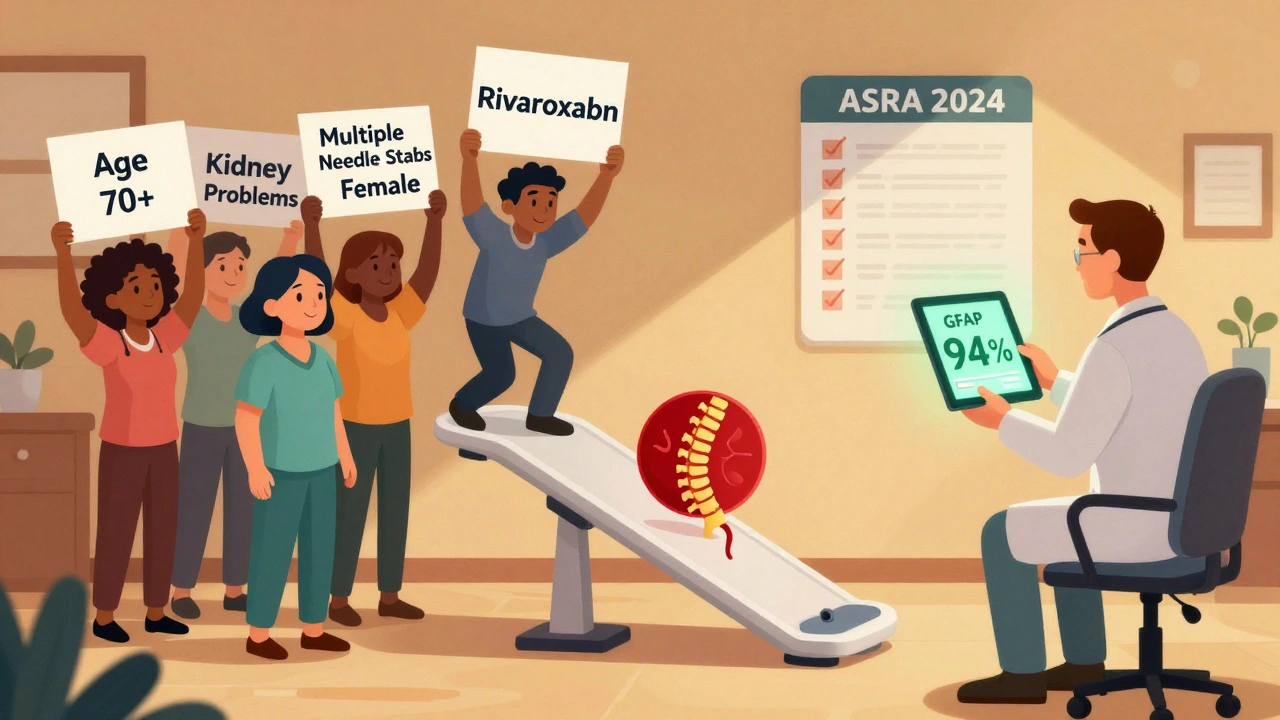
It’s not just about the drug. Your body matters too.- Age over 70: Your blood vessels are more fragile. Risk increases 3.7 times.
- Chronic kidney disease: If your creatinine clearance is under 30 mL/min, your body can’t clear anticoagulants well. Risk jumps nearly 5 times.
- Spinal stenosis or previous spine surgery: Scar tissue and narrow spaces make it easier for blood to compress the cord. Risk is 2.8 times higher.
- Multiple needle attempts: If the anesthesiologist has to poke more than three times, your risk goes up 6.2 times.
- Blood-tinged fluid: If the needle hits a blood vessel and you see red in the spinal fluid, your risk increases 11.8 times.
- Low hemoglobin or major blood loss: If your hemoglobin is under 10 g/dL or you lose over 1 liter of blood during surgery, your risk doubles or triples.
And here’s something new: women may be at higher risk. Data from the European Spinal Anaesthesia Registry shows women develop SEH 2.3 times more often than men-even when on the same drugs, same doses, same timing. Why? No one knows yet. Maybe anatomy. Maybe hormones. But it’s a red flag.
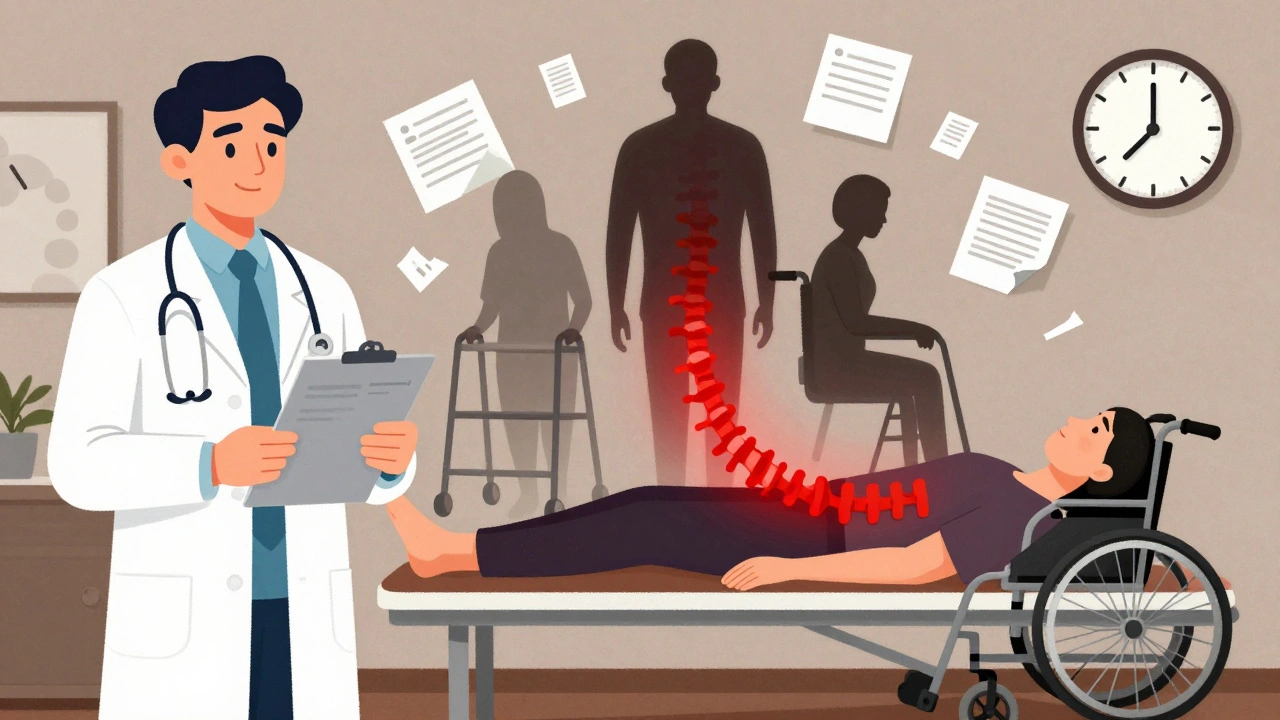
What Happens If You Don’t Follow the Rules?
The FDA reviewed 170 cases of spinal hematoma linked to anticoagulants. In 34% of those cases, the patient’s anticoagulant status wasn’t properly documented. That’s not a mistake. That’s negligence.One patient, on warfarin, had her INR checked the day before surgery. It was 1.2. The team proceeded. She woke up with numb legs. An MRI showed a 5 mL hematoma. She had emergency surgery within 6 hours. Still, she lost sensation in both feet. Permanent. She’s 52. She uses a walker.
Another case: a woman on therapeutic enoxaparin had a spinal for a C-section. Her last dose was 14 hours before. Guidelines say 24. She developed weakness 10 hours later. Surgery came too late. She’s paralyzed from the waist down.
These aren’t outliers. They’re preventable.
How to Stay Safe: The Real-World Checklist
If you’re on blood thinners and need a spinal or epidural procedure, here’s what you need to do:- Know your drug and dose. Don’t assume your doctor does. Bring a list: name, dose, last time taken.
- Check your INR if on warfarin. Must be under 1.4. Get it tested within 24 hours before the procedure.
- Stop LMWH at least 10-12 hours before (prophylactic) or 24 hours before (therapeutic). Don’t guess. Write it down.
- Stop DOACs 48 hours before (normal kidneys) or 72 hours before (impaired kidneys). Apixaban and rivaroxaban are the most common. Don’t confuse them with aspirin.
- Stop dual antiplatelets (aspirin + clopidogrel) 7 days before. Aspirin alone? Usually fine, but confirm with your team.
- Ask: How many attempts will be made? If the provider says they’ll try three times, push back. One or two is ideal.
- Ask: Will you monitor me after? You should be checked every hour for the first 6-12 hours for back pain, leg weakness, or bladder issues.
- Don’t assume ‘no pain’ means ‘no problem.’ Symptoms can be delayed. If you feel tingling in your groin or can’t pee 12 hours after the procedure, demand an MRI.
Use tools like the ASRA Anticoagulation Checklist or the ‘Neuraxial Anticoag’ app. But verify their dates. A 2021 study found 17% of apps had outdated info.
What If You Can’t Stop Your Blood Thinners?
Some patients can’t stop anticoagulants. Think: mechanical heart valves, recent stroke, active clots. For them, spinal procedures are high-risk-but not always impossible.Alternatives exist:
- General anesthesia: No spinal needle. No hematoma risk.
- Peripheral nerve blocks: Numb just the leg or arm. No spine involved.
- IV pain meds: Not ideal, but safer than a spinal with active anticoagulation.
Some centers now use ultrasound-guided techniques to avoid the epidural space entirely. Others use a “bridging” strategy-switching from DOAC to short-acting heparin, then timing it precisely. But that’s complex. It’s not for every hospital. Ask if your team has experience.
What’s Changing in 2025?
The FDA now requires all anticoagulant manufacturers to include specific warnings about neuraxial procedures in their labeling. Hospitals in the U.S. must report SEH cases if they perform more than 50 spinal procedures a year-starting January 2025. That’s a big shift. It means this isn’t just a medical issue anymore. It’s a safety mandate.Researchers are also testing new tools. A 2022 study found that a blood test measuring GFAP (a protein released when spinal nerves are damaged) can predict a hematoma within 2 hours-with 94% accuracy. That could change everything. Imagine knowing you’re bleeding before you feel pain.
And guidelines are evolving. The 2024 ASRA update (coming soon) will include a risk-scoring system. You’ll answer 12 questions-age, kidney function, drug type, number of needle passes-and get a score. Over 15? High risk. Alternative pain control needed.
Final Thought: It’s Not About Fear. It’s About Control.
You don’t need to avoid spinal procedures if you’re on blood thinners. You just need to be informed. This isn’t about saying no. It’s about saying, “I know the risks. Let’s do this right.”Ask your anesthesiologist: “What’s my specific risk based on my drug and health?” Show them your meds. Ask about the timing. Ask if they’ve ever had a patient with a spinal hematoma. If they hesitate, find someone else.
Because when it comes to blood thinners and spinal needles, the difference between a safe procedure and a life-changing injury isn’t luck. It’s preparation.
Can I still get an epidural if I take aspirin daily?
Yes, in most cases. Aspirin alone carries a very low risk-about 0.03%-and studies of over 1,200 patients found zero hematomas when aspirin was continued. Most guidelines allow it. But if you’re on aspirin plus another antiplatelet like clopidogrel, you should stop both for at least 7 days before the procedure. Always confirm with your anesthesiologist.
How long after a spinal procedure can I restart my blood thinner?
It depends on the drug and whether you had a single injection or a catheter. For warfarin, restart 4 hours after a single injection, 6 hours after a catheter. For LMWH, wait 2 hours after single injection, 4 hours after catheter. DOACs like apixaban or rivaroxaban should be restarted 24 hours after a single injection, or 48 hours after a catheter-only if there’s no bleeding. Always follow your provider’s instructions.
What if I have kidney problems and take a DOAC?
If your kidney function is poor (creatinine clearance under 30 mL/min), your body clears drugs like rivaroxaban and apixaban much slower. That means the drug stays in your system longer. You need to stop it 72 hours before the procedure-not 48. If you’re unsure, get a blood test to check your kidney function before scheduling. Many patients don’t realize this until it’s too late.
Can a spinal hematoma happen even if my INR is normal?
Yes. There are documented cases of spinal hematomas in patients on warfarin with INR levels of 1.0 or 1.2. This suggests that even "normal" clotting times don’t guarantee safety. Factors like needle trauma, multiple attempts, or underlying spinal issues can still trigger bleeding. That’s why timing, technique, and monitoring matter just as much as lab values.
Is it safe to get a spinal for labor if I’m on blood thinners?
It’s possible, but only under strict conditions. For women on low-dose LMWH for pregnancy-related clots, guidelines allow epidural if the last dose was given at least 12 hours before labor. For DOACs, stop 48 hours before. Warfarin requires INR under 1.4. But because labor is unpredictable, many hospitals avoid spinal anesthesia unless the anticoagulation is perfectly timed and monitored. Always discuss this with your OB and anesthesiologist early in pregnancy.
What are the signs I should watch for after a spinal procedure?
Watch for: sudden severe back pain, numbness or tingling in your legs or groin, weakness in your legs, trouble urinating or having a bowel movement, or loss of sensation in your saddle area (buttocks, inner thighs). These can start within hours. If you notice any of these, tell your nurse immediately. Don’t wait. Early detection saves movement.
Are newer anticoagulants safer than older ones?
They’re easier to use, but not necessarily safer. DOACs like apixaban have slightly lower hematoma rates than warfarin or LMWH when used correctly. But if you take them too close to the procedure or have kidney issues, the risk spikes. Plus, we have less long-term data on them. A 2023 case report showed a hematoma after edoxaban-even with 72 hours of stopping. So don’t assume newer means safer. Timing still matters most.






14 Comments
bro i got an epidural last year on Eliquis and they just said 'eh, youll be fine'... turns out i was numb from the waist down for 3 weeks. they didn't even check my kidney function. this post is literally a horror movie script and nobody talks about it. i'm still pissed.
I can't believe hospitals still let this happen. My cousin had a spinal for a c-section and they didn't even wait 24hrs after her Lovenox. Now she's in a wheelchair. This isn't 'risk'-it's negligence dressed up as 'standard practice'. #WakeUpHealthcare
It's terrifying how much of our medical safety relies on a single provider remembering one detail out of a hundred. We treat anticoagulants like they're vitamins... but they're more like live grenades in a crowded room. I wonder how many people have lost mobility and no one ever connected the dots. We need systems, not just checklists.
Let me guess-someone’s gonna say 'but aspirin’s fine!' like it’s a free pass. Bro, I had a 52-year-old patient with INR 1.1, no kidney issues, one needle stick, and BAM-paralysis. The needle didn’t even hit a vessel. The docs thought 'normal INR = safe'. Spoiler: it’s not. This isn’t medicine, it’s Russian roulette with a spinal needle. And don’t even get me started on those sketchy apps that say 'stop DOACs 24hrs'... outdated as a dial-up modem.
I’ve been an anesthesiologist for 22 years and I still double-check every single med list. I don’t care if the patient says 'my cardiologist said it’s fine'-I check the lab, I ask the timing, I write it down. This isn’t about fear. It’s about respect. You’re not just injecting numbing fluid-you’re risking someone’s ability to walk. Always assume the worst. Then prepare for it.
Hey everyone-just wanted to say thank you to the OP. This is the kind of info I wish I’d had when my mom had her hip replacement. She’s 76, on rivaroxaban, had kidney issues, and they almost skipped the INR check. I stepped in and demanded the full checklist. She’s fine now. Knowledge is power. Share this with your family.
This is all just fearmongering. People die from car accidents every day. Why are we treating a 1 in 150k risk like it’s a pandemic? The real danger is overmedicalizing everything. Let people make their own choices. If you want to be paralyzed, go ahead. But don’t make me feel guilty for wanting a pain-free birth.
OMG how is this even legal?? People are just walking into hospitals with blood thinners and getting needles stuck in their spine?? My aunt died because of this and the hospital said 'it was an unfortunate complication'. UNFORTUNATE?? They didn't even check her creatinine!! This is murder by bureaucracy. Someone needs to go to jail.
I’m a nurse and I’ve seen this go wrong twice. The worst part? The patients never know what to ask. They trust the doctor. I always hand them this checklist printed out. One woman cried and said, 'No one’s ever explained it like this.' If you’re on anticoagulants, print this. Bring it. Don’t wait for them to ask you.
I’m on Xarelto for AFib. I just had a knee scope and they made me stop it 72 hours early because I have mild CKD. They didn’t even tell me why until I asked. Why is this info so hidden? Why do I have to be the one to dig it up? I’m not a doctor. I’m just trying to not get paralyzed.
LMAO people are losing their minds over a 0.08% risk. I had an epidural on warfarin with INR 1.3 and I’m fine. You’re all acting like this is a horror movie. Chill. The real risk is you stressing yourself out so much you get a heart attack.
I’m from India and we don’t have the same access to guidelines here. My cousin’s doctor said 'aspirin is safe' and she got a hematoma. No one knew about the 7-day rule for dual antiplatelets. This post is a lifeline. Can someone translate this into Hindi? We need this in rural clinics too.
I’ve been thinking… what if this is all a drug company ploy? DOACs cost 10x more than warfarin. Maybe they’re pushing the 'newer = safer' myth so people don’t switch back. And now hospitals are forced to report cases-sounds like a liability shield. Who benefits? Not the patient.
This was so helpful. I’m scheduled for a spinal next month and I’m on Eliquis. I’m printing this out and handing it to my anesthesiologist. No more assumptions. I’ve got my kidney test results ready too. Thank you for writing this.