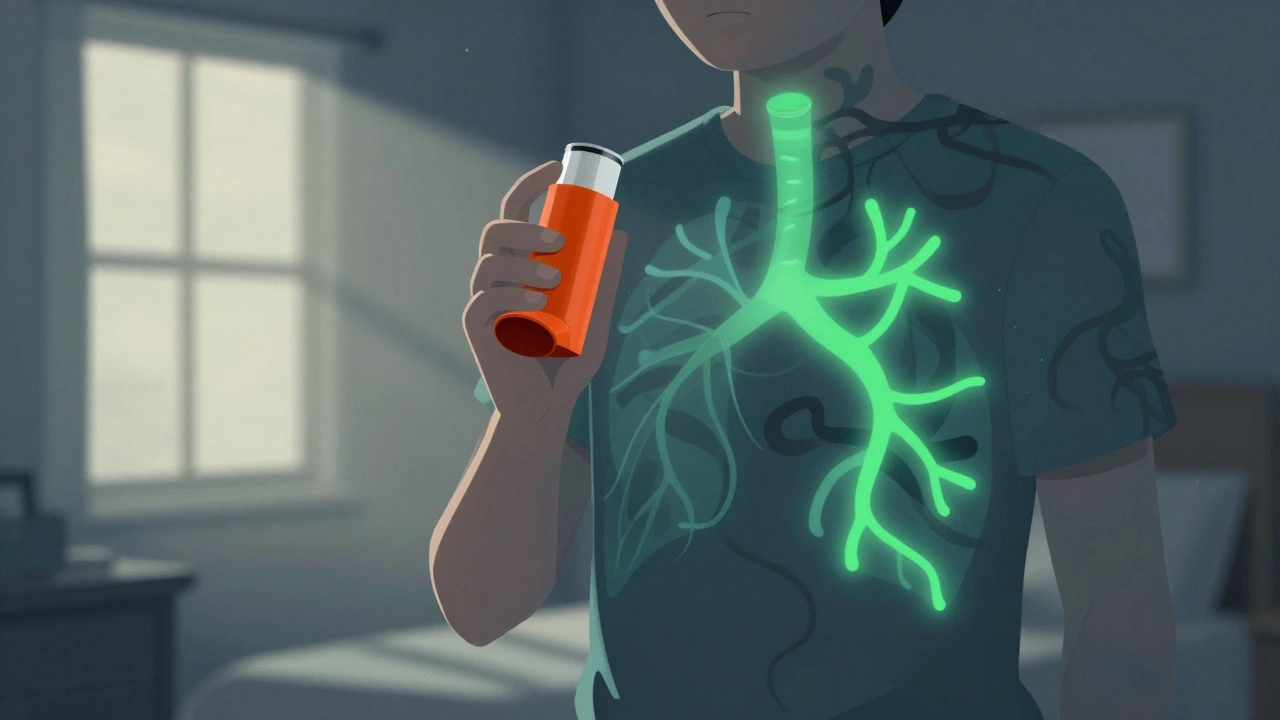

Fluticasone-salmeterol isn’t just another inhaler. For people living with moderate to severe asthma, it’s often the difference between breathing normally and struggling through every day. But here’s the thing-taking your inhaler twice a day doesn’t fix everything. Asthma isn’t just about airways and medication. It’s about fear, fatigue, isolation, and the quiet panic that comes when you feel like no one else gets it. That’s where support groups step in-not as a replacement for medicine, but as the missing piece many doctors never talk about.
What fluticasone-salmeterol actually does
Fluticasone-salmeterol is a combo inhaler. One part, fluticasone, is a corticosteroid that reduces swelling and mucus in your airways. The other, salmeterol, is a long-acting bronchodilator that keeps your airways open for up to 12 hours. Together, they work to prevent asthma attacks, not just treat them. It’s not a rescue inhaler like albuterol. You don’t use it when you’re wheezing. You use it every day, rain or shine, even when you feel fine.
Studies show that people who take fluticasone-salmeterol regularly cut their risk of hospital visits by nearly 40% compared to those who only use rescue inhalers. That’s not a small number. It’s life-changing. But sticking to a daily routine for something you can’t feel working is hard. You skip a dose because you’re tired. You forget because your life got busy. Then, one morning, your chest tightens, and you’re back in the emergency room.
Why medication alone isn’t enough
Doctors give you a prescription and hope you follow it. But asthma management isn’t a checklist. It’s a daily battle against invisible triggers-cold air, pollen, stress, even laughter. And when you’re constantly worrying about the next attack, it wears you down. Sleep suffers. Work suffers. Relationships suffer. You start avoiding things you love: hiking, singing, playing with your kids.
A 2023 study in the Journal of Allergy and Clinical Immunology found that asthma patients who felt socially isolated were twice as likely to have uncontrolled symptoms-even when their medication use was perfect. The problem isn’t the drug. It’s the loneliness.
How support groups make a real difference
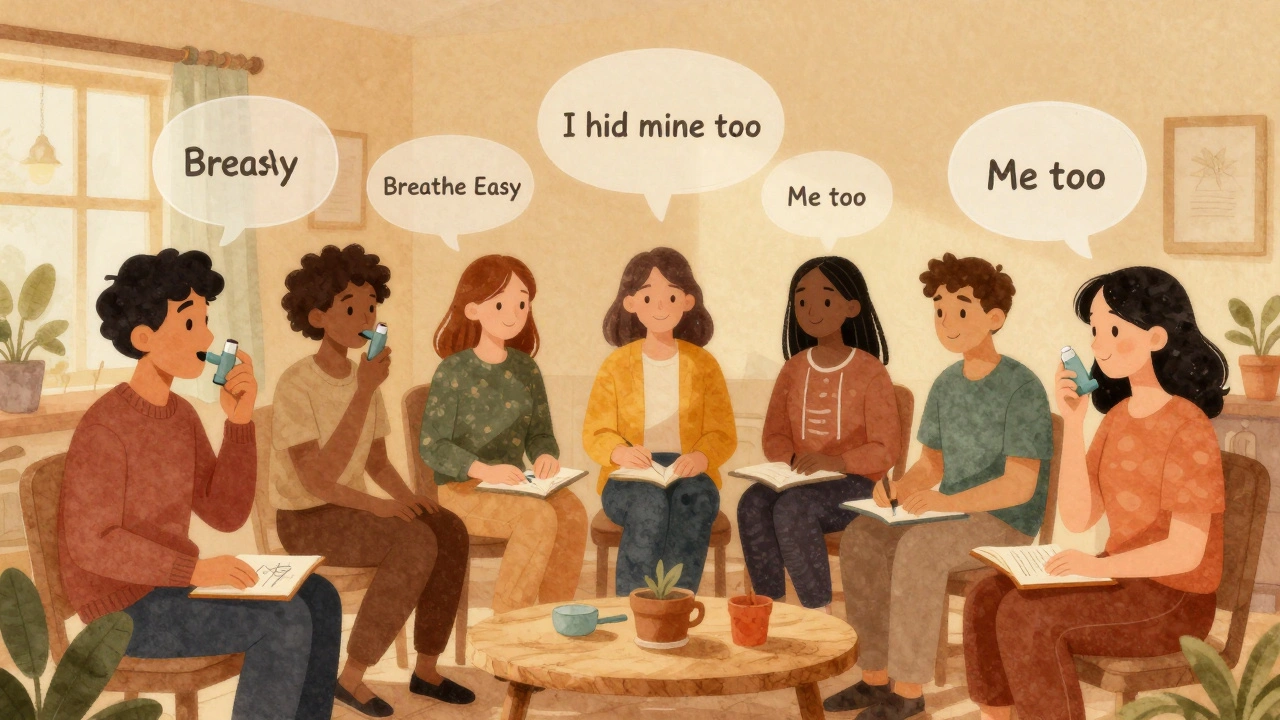
Support groups for asthma aren’t therapy sessions. They’re not lectures. They’re just people sitting in a room-online or in person-telling the truth. One woman talks about how she stopped taking her inhaler because she hated the taste. Another admits he only uses it when he’s scared. Someone else shares how she learned to use her spacer correctly after watching a video a group member made.
These groups work because they’re not led by doctors. They’re led by people who’ve been there. No jargon. No pressure. Just: “I get it.”
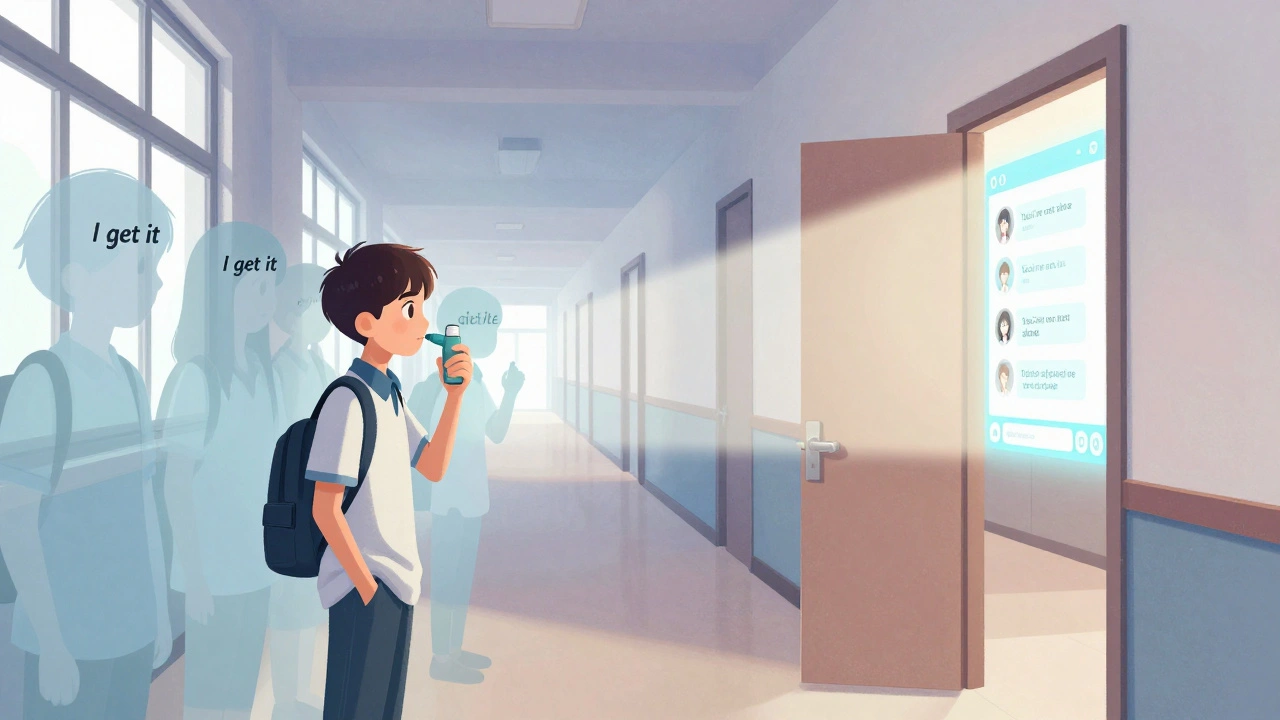
In Dunedin, a local group meets every Thursday at the community center. They don’t call it “Asthma Support.” They call it “Breathe Easy.” No one’s expected to speak. You can just sit and nod. But over time, people start sharing. One guy learned how to track his symptoms using a free app after someone else showed him. A teenager who was too embarrassed to use her inhaler in school started carrying it openly after hearing another teen say, “I used to hide mine too. Now I just say, ‘It’s my life raft.’”
What to look for in a good support group
Not all groups are created equal. Some are run by pharmaceutical companies and feel like ads. Others are chaotic, with no structure. Here’s what actually works:
- Peer-led, not doctor-led-The best groups are run by people with asthma, not healthcare workers. They know what it’s like to forget your inhaler at work or panic before a flight.
- Real talk only-No sugarcoating. If someone says, “I stopped taking mine for six months,” the group doesn’t judge. They ask, “What made you start again?”
- Practical tips-How to clean your spacer. How to talk to your boss about asthma days. Where to buy affordable inhalers in New Zealand.
- No sales pitches-If someone’s trying to sell you a supplement or a “miracle cure,” leave.
Groups that follow these rules see better medication adherence, fewer ER visits, and higher quality of life scores. It’s not magic. It’s human connection.
What if there’s no group near you?
You don’t need to drive across town. Online groups work just as well. The Asthma and Allergy Foundation of America runs a moderated forum with over 15,000 members. Facebook has private groups like “Asthma Warriors NZ” with 3,200 active users. Reddit’s r/Asthma is quiet but full of honest stories.
One woman from Invercargill joined an online group after her doctor told her to “just use the inhaler.” She didn’t say anything for three weeks. Then she posted: “I cried today because I couldn’t play with my dog. I didn’t know anyone else felt this way.” Within hours, 47 people replied. One sent her a link to a budget-friendly spacer. Another shared how they used a humidifier to cut down on morning attacks. She didn’t get a new prescription. She got a community.
How to start your own group
If you can’t find one that fits, start one. It doesn’t take much. You need a space-a Zoom link, a library meeting room, even a coffee shop corner. Post on local Facebook groups. Ask your pharmacist if they’ll put up a flyer. Tell your doctor you’re doing it-they might even help you find others.
Keep it simple:
- Meet once a month.
- Let people talk first. Don’t lead with advice.
- Share one practical tip each time-like how to read your inhaler’s dose counter.
- No pressure to speak. No rules except kindness.
In Christchurch, a retired teacher started a group after her grandson’s asthma got worse. Two years later, five families meet every week. They don’t talk about fluticasone-salmeterol much. They talk about school trips, sleepless nights, and how to keep their kids calm during pollen season. The inhaler is just the tool. The group is the safety net.
The hidden cost of untreated emotional stress
Stress doesn’t cause asthma. But it makes it worse. When you’re anxious, your airways tighten. Your body releases chemicals that increase inflammation. That’s why people who feel alone often end up in the hospital-even if their meds are on point.
Support groups lower stress. Not by giving advice, but by giving presence. When you say, “I’m scared to go to the beach because of the wind,” and someone else says, “Me too. I carry my inhaler in my swimsuit,” you don’t feel broken anymore. You feel understood.
A 2024 study from the University of Otago tracked 200 asthma patients over a year. Those who joined a support group reduced their rescue inhaler use by 31% compared to those who didn’t-even though both groups had the same medication access. The only difference? Connection.
It’s not about being strong. It’s about being together.
Fluticasone-salmeterol keeps your lungs open. But it doesn’t fix the loneliness. It doesn’t ease the guilt when you miss your kid’s soccer game because you couldn’t breathe. It doesn’t help you sleep when you’re afraid you won’t wake up.
Support groups do. They remind you that you’re not failing. You’re not weak. You’re just human. And you’re not alone.
Take your inhaler. Then, find your people. They’re out there. And they’re waiting for you to say, “Me too.”
Can fluticasone-salmeterol be used as a rescue inhaler?
No. Fluticasone-salmeterol is a maintenance inhaler meant for daily use to prevent asthma attacks. It does not work quickly enough to relieve sudden symptoms like wheezing or shortness of breath. Always keep a fast-acting rescue inhaler, like albuterol, on hand for emergencies.
How long does it take for fluticasone-salmeterol to start working?
The salmeterol component starts opening airways within 30 minutes, but it takes up to a week of daily use for the full anti-inflammatory effect of fluticasone to build up. Don’t stop taking it if you don’t feel better right away. Consistency is key.
Are support groups only for people with severe asthma?
No. Support groups help anyone living with asthma, whether it’s mild, moderate, or severe. Even if you only use your inhaler once a week, you might still feel isolated or anxious. These groups are for anyone who wants to talk, learn, or just sit with others who get it.
Can children join asthma support groups?
Yes. Many groups have separate sessions for kids and teens, or family-friendly meetings where parents and children attend together. Some groups even include games or activities to help younger members learn about asthma in a safe, fun way.
Is it safe to stop taking fluticasone-salmeterol if I feel fine?
No. Even if you feel fine, stopping fluticasone-salmeterol can lead to a flare-up. The medication works behind the scenes to reduce inflammation. Stopping suddenly increases your risk of severe attacks. Always talk to your doctor before making changes.




11 Comments
Let me get this straight - you’re telling me people need a support group just to remember to use their inhaler? My grandma didn’t have a Facebook group for her high blood pressure and she lived to 92. This is just medicalization of laziness wrapped in feel-good buzzwords.
Fluticasone-salmeterol isn’t magic. It’s chemistry. Support groups aren’t therapy. They’re emotional band-aids on a structural problem. If your disease requires a community to function, maybe the system failed you - not your lungs.
It is a well-documented phenomenon in clinical psychology that non-pharmacological interventions, when improperly implemented, can induce a false sense of therapeutic efficacy. The reliance on peer-led groups, particularly in the absence of standardized protocols or outcome metrics, constitutes a regression in patient care standards. One must ask: Is this compassion - or negligence disguised as solidarity?
Yeah okay
I used to think asthma was just about breathing until I started having panic attacks before I even left the house because I forgot my inhaler and my partner didn’t understand why I couldn’t just push through it and then I found this little online group where someone posted a photo of their kid’s glitter-covered spacer and I cried because no one had ever said it was okay to be scared and not okay to be strong all the time and now I carry mine in my sock drawer so I don’t forget and I tell my coworkers it’s my lifeline and they don’t laugh anymore and I don’t feel like a burden anymore and I didn’t need a doctor to tell me that connection matters because I already knew it I just didn’t know anyone else did too
Bro this is literally the most real thing I’ve read all year 🤍 I used to hide my inhaler like it was contraband until I saw someone say ‘it’s my life raft’ and now I just hold it up like a trophy when I walk into a room. Also I bought a humidifier and my nights are finally quiet. Thanks for writing this.
My brother’s been on this inhaler for 8 years. He’s never been hospitalized since he joined a local group. Not because of the meds - because he finally stopped feeling like a burden. This isn’t fluff. It’s science with a heartbeat.
Man I read this in India and I felt you. Here people think asthma is just for kids or rich people with AC. My cousin died because his family thought he just needed more chai. I found a WhatsApp group of 200 people from Mumbai to Kerala and we share cheap spacer hacks and how to beg doctors for free samples. This isn’t support - it’s survival.
It is worth noting that the placebo effect, when amplified through communal reinforcement, may account for a significant proportion of the observed reduction in rescue inhaler usage. The biochemical efficacy of fluticasone-salmeterol remains unchanged; what has shifted is the psychological attribution of symptom control. One must be cautious not to conflate correlation with causation.
Wait so you’re saying if I feel alone then I’m gonna die? That’s not true. I’ve been on this inhaler for 12 years and I’ve never been to a group and I’m fine. Why do people need to feel seen to breathe? It’s not a TED Talk it’s medicine. Also I saw someone say they cried because they couldn’t play with their dog - well my dog died last year so I guess my grief doesn’t count because I didn’t join a group? Just saying.
Ah yes - the modern myth of the ‘community as cure.’ How poetic. How tragically postmodern. We have replaced the sacred silence of suffering with the cacophony of shared vulnerability. The inhaler is a tool of molecular precision. The group? A mirror - and mirrors, my dear friends, do not heal. They reflect. And what they reflect… is our collective failure to confront the true nature of chronic illness: it is solitary. Always has been. Always will be.