


When it comes to losing weight, most people assume the answer is simple: do more cardio. Run longer, cycle harder, sweat more on the treadmill. But what if the scale isn’t moving - even after months of running? And what if your clothes are fitting better, but the number on the scale hasn’t budged? That’s not a failure. It’s your body changing in ways the scale can’t show.
The truth is, cardio and strength training don’t do the same thing. One burns calories fast. The other changes how your body burns calories all day, every day. Choosing one over the other isn’t just a matter of preference - it’s a matter of biology.
Cardio Burns Calories During the Workout - But That’s Only Half the Story
Cardio, or cardiovascular exercise, includes anything that keeps your heart pumping for a sustained time: running, swimming, brisk walking, cycling, dancing. It’s the go-to for people who want to see quick results on the scale.
For a 155-pound person, 30 minutes of moderate jogging burns around 300-400 calories. Cycling at 12-14 mph? 250-600 calories. Swimming laps? 200-500. These numbers look impressive. And they are - for the moment.
But here’s the catch: once you stop moving, your calorie burn drops back to baseline. That’s it. No lingering effect. You burn what you burn during the workout, then your body resets.
That’s why so many people hit a wall. After 8-12 weeks of steady cardio, the body adapts. You’re not burning more calories just because you’re doing more. You might even start eating more because you feel hungrier. The scale stalls. People get discouraged. They think they’re doing something wrong.
But it’s not you. It’s the limitation of cardio alone.
Strength Training Burns Fewer Calories - But It Changes Your Body Forever
Now, let’s talk about strength training. Lifting weights, doing push-ups, using resistance bands - these don’t burn as many calories during the session. A 30-minute weight session burns only 90-150 calories. Even intense circuits max out around 250.
At first glance, that seems like a bad deal. Why lift if you’re burning less than half the calories of a run?
Because strength training doesn’t end when you put the dumbbells down.
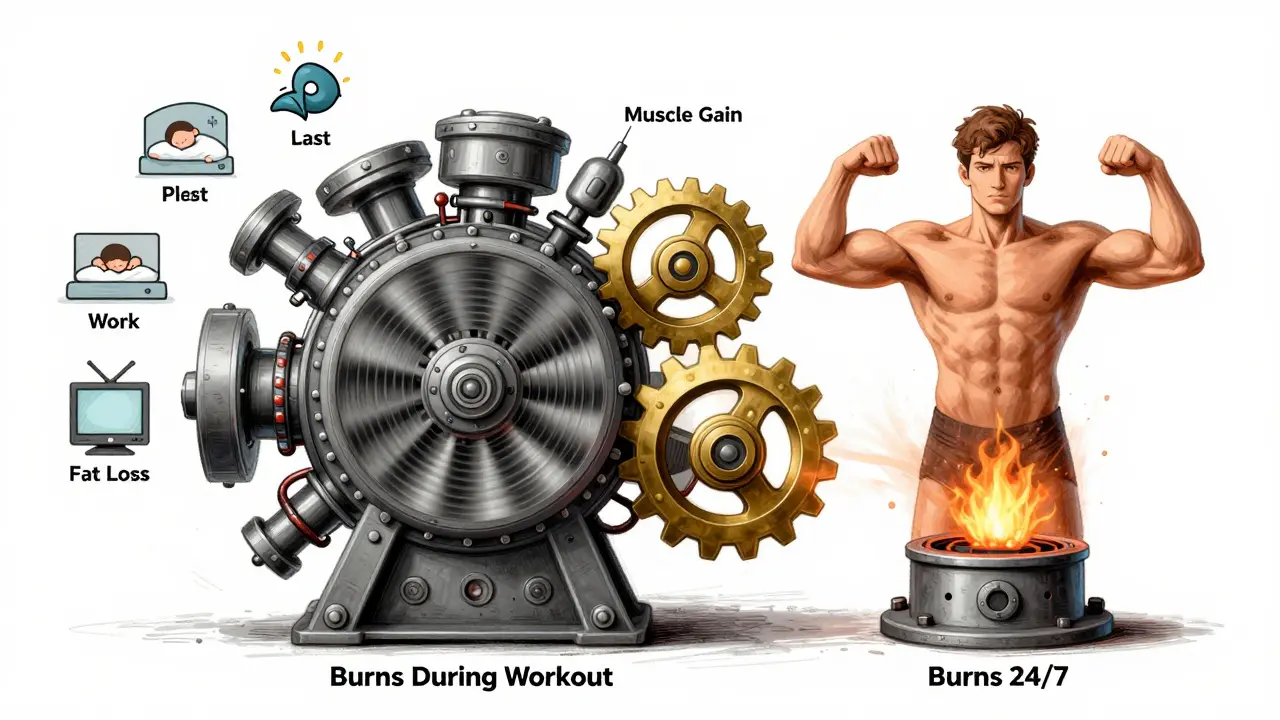
After a hard strength session, your body works overtime to repair muscle tissue. This is called excess post-exercise oxygen consumption - or EPOC. Your metabolism stays elevated for up to 48 hours. That means you’re burning extra calories while you sleep, while you work, while you watch TV.
And here’s the real game-changer: muscle burns more calories at rest than fat.
Every kilogram of muscle uses 13-15 calories a day just to exist. Fat? Only 4.5-5. That’s a 20-30% higher resting metabolic rate if you gain 10% more muscle. You don’t need to be a bodybuilder. Just adding 1.5-2kg of lean mass can mean burning an extra 100-150 calories daily - without doing a single rep.
That’s the difference between losing weight and losing fat while keeping your metabolism strong.
The Science Says: Combine Both - Not Choose One
Multiple studies from 2019 to 2024 show the same thing: the best results come from combining cardio and strength training.
In one 6-month trial published in Obesity, participants who did 150 minutes of cardio and 120 minutes of strength training each week lost 12.4% body fat - and gained 1.8kg of muscle. The cardio-only group lost 9.7% fat - but also lost muscle. The strength-only group gained muscle but lost less fat.
Another study tracked 473 overweight adults over 8 months. The cardio group lost 4.3% of their body weight. The strength group lost only 1.6%. But the strength group gained 1.4kg of muscle. The cardio group lost 0.2kg.
That’s the difference between looking thinner and looking stronger. Between losing weight and improving body composition.
And it’s not just about numbers. People who combine both report better results in real life. A 2023 analysis of the National Weight Control Registry - which tracks people who’ve lost 30kg or more and kept it off for at least five years - found successful maintainers averaged 220 minutes of cardio weekly. But those who kept the most muscle did 3 or more strength sessions a week.
They didn’t just lose weight. They kept it off.
What People Actually Experience - The Real Stories
Look at Reddit threads from people who’ve tried both. The top post on r/Fitness with 3,450 upvotes asked: “6 months cardio vs weights for fat loss.”
68% of people who combined both lost more than 15% body fat. Only 42% of cardio-only users hit that mark. Just 31% of strength-only users did.
Cardio users loved the immediate scale drop. “I lost 5kg in 3 weeks,” one wrote. But then: “Then it stopped. I felt tired all the time.”
Strength users often had a different experience. “The scale went up at first,” said one. “I thought I was failing. Then my jeans got looser. My arms looked defined. After 3 months, I was burning more energy even sitting at my desk.”
That’s the water retention myth - new strength trainers often gain 1-2kg at first because muscles hold more water. It’s temporary. It’s normal. It’s not fat.
And the long-term? A 2023 survey of 25,000 MyFitnessPal users found those tracking both cardio and strength kept 72% of their weight loss after 18 months. Single-modality users? Only 48%.
How to Actually Do This - No Guesswork
You don’t need to spend hours at the gym. You don’t need fancy equipment. You just need structure.
Here’s what works for most people:
- Start with 3 days of cardio per week - 20-30 minutes of brisk walking, cycling, or swimming. Keep it at a pace where you can talk but not sing.
- Add 2 days of strength training - full-body workouts using bodyweight or dumbbells. Focus on squats, push-ups, rows, and lunges. Do 3 sets of 8-12 reps per exercise.
- Progress slowly. Each week, add 2.5-5% more weight or do 1-2 more reps. If you’re not getting harder, you’re not getting stronger.
- Protein matters. Aim for 1.6-2.2 grams of protein per kilogram of body weight daily. If you weigh 70kg, that’s 112-154g of protein. Eggs, chicken, tofu, Greek yogurt, lentils - these aren’t optional. They’re the building blocks.
- Rest is part of the plan. Muscles grow when you rest, not when you lift. Don’t train the same muscle group two days in a row.
Beginners often skip protein or don’t increase resistance. That’s why 78% of new strength trainers plateau within 6 weeks. It’s not genetics. It’s not bad luck. It’s just not progressive.
What About HIIT? Is It the Secret Weapon?
High-intensity interval training - short bursts of all-out effort followed by rest - is a hybrid that gives you both.
HIIT burns 25-30% more calories than steady-state cardio. And it triggers 12-15% more EPOC than traditional cardio. That means you get the calorie burn of a long run - in 20 minutes.
Try this: 30 seconds of sprinting or jumping jacks, 60 seconds of walking. Repeat 6-8 times. Do it twice a week. Replace one of your cardio days. You’ll save time and get better results.
The Bigger Picture: Exercise Isn’t Just About Burning Calories
Dr. James Levine from Mayo Clinic says non-exercise activity thermogenesis - NEAT - matters more than you think. That’s walking to the mailbox, standing while you talk on the phone, fidgeting, taking the stairs. It can burn 2-3 times more calories than a gym session.
So don’t think of exercise as the only way to lose weight. Think of it as the way to make your body better at burning calories - even when you’re not working out.
Cardio improves your heart. Strength training improves your body’s engine. Together, they make your metabolism more flexible, more resilient, more efficient.
The best weight loss strategy isn’t about doing the most. It’s about doing the right things - consistently - so your body becomes the kind of machine that burns fat without you having to try.
What’s Next? Don’t Just Exercise - Optimize
Technology is catching up. Wearables like Garmin and Apple Watch now track EPOC and metabolic rate. AI-driven programs are starting to recommend personalized cardio-strength ratios based on your genes and metabolism.
But you don’t need a $500 watch or a DNA test. Start simple:
- Track your workouts - even just on paper.
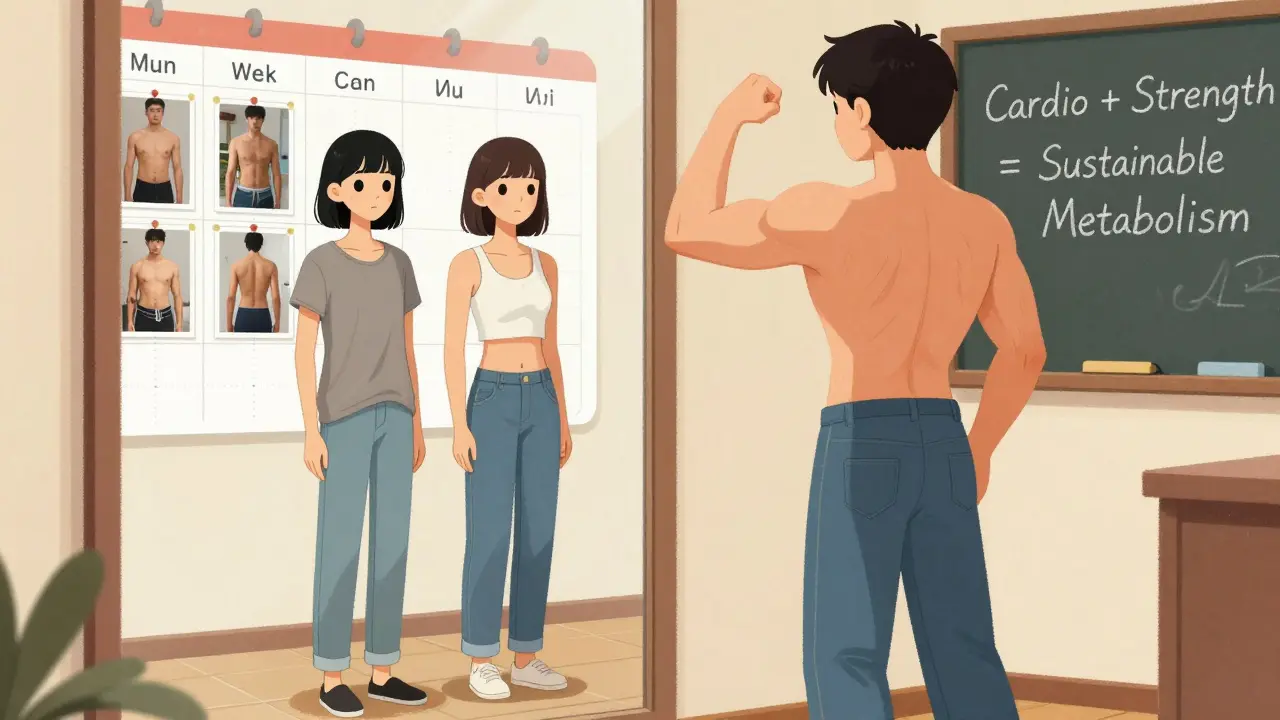
- Take a photo every 4 weeks. Clothes fit better? That’s progress.
- Measure your waist - not just your weight.
- Focus on consistency, not perfection.
People who stick with both cardio and strength training don’t win because they’re stronger. They win because they built a body that works for them - not against them.
Is cardio or strength training better for losing belly fat?
Neither one targets belly fat specifically - fat loss happens all over the body. But combining cardio and strength training gives you the best shot. Cardio burns more calories during the workout, while strength training increases your resting metabolism, helping you burn fat even when you’re not active. Studies show people who do both lose more body fat overall than those who do just one.
Why am I gaining weight even though I’m working out?
If you’ve started strength training, the scale might go up because muscle is denser than fat. You could be losing fat but gaining muscle - which means your body composition is improving, even if your weight stays the same or increases. Check your waist measurement, how your clothes fit, and take progress photos. The scale doesn’t tell the whole story.
How much cardio and strength training should I do each week?
For most people aiming to lose weight, aim for 150 minutes of moderate cardio (like brisk walking or cycling) and 120 minutes of strength training per week. That’s about 3 days of cardio and 2 days of strength. Beginners can start with 3 days of 20-30 minutes each and build up. Consistency matters more than intensity.
Can I lose weight with strength training alone?
Yes - but slower. Strength training builds muscle, which increases your resting metabolism. Over time, that helps you burn more calories daily. But because it burns fewer calories during the workout, weight loss may be slower than with cardio. Most people see better results when they combine both.
Do I need to lift heavy to build muscle and lose fat?
No. You don’t need to lift Olympic weights. What matters is progressive overload - gradually making your workouts harder. If you’re doing bodyweight squats, add a dumbbell. If you’re doing push-ups on your knees, try full push-ups. If you’re using light bands, switch to heavier ones. Any resistance that challenges you - and that you increase over time - will build muscle.
How long until I see results from strength training?
You’ll start feeling stronger in 2-4 weeks. Visible muscle changes usually take 8-12 weeks. Fat loss depends on your diet and overall activity, but most people notice their clothes fitting better after 4-6 weeks of consistent training - even if the scale hasn’t moved.
Is walking enough cardio for weight loss?
Yes - if you do enough of it. Walking at a brisk pace (about 5 km/h) burns 200-300 calories per hour. To lose weight, aim for 150-220 minutes per week - that’s 30-45 minutes most days. Walking is low-impact, sustainable, and perfect for beginners. Add inclines or a weighted vest to increase the burn.
If you’re serious about losing weight and keeping it off, don’t pick sides. Use both. Cardio clears the path. Strength training builds the engine. Together, they make your body work smarter - not harder.




11 Comments
Cardio is for people who think exercise is punishment
Strength training is for people who understand the body is a system not a calorie calculator
You don't train to burn calories you train to become a more efficient organism
Modern fitness is a capitalist scam selling sweat as virtue
Stop confusing movement with meaning
YES THIS!! 😊 I was skeptical at first but switched from running 5x a week to 3x cardio + 2x weights and my energy skyrocketed
My jeans fit looser even though I gained 2 lbs on the scale
Trust the process - muscle is magic 💪
Study says combine both
Study funded by gym equipment companies
Also 72% retention rate? Where's the p-value?
Correlation ≠ causation
Most people who do both are also dieting
Also who tracks 18 months of MyFitnessPal data? That's a self-selecting sample
You're all missing the point
Cardio is a distraction
It's the dopamine hit of movement without the structural integrity
Strength is the only true rebellion against entropy
Every rep is a middle finger to decay
Your mitochondria don't care about your step count
They care about tension
They care about overload
They care about adaptation
Cardio makes you tired
Strength makes you immortal
And yes I've read the studies
They're all written by people who've never deadlifted 2x their bodyweight
And if you're still counting calories you're still a slave
Food is not a math problem
It's a relationship
And your body isn't a bank account
It's a cathedral
Been doing this for 6 months now - 3 days walk, 2 days bodyweight at home
My lower back pain is gone
My sleep is better
And I don't feel like I'm starving myself all day
Protein tip is gold - I started eating eggs and lentils daily
Biggest change? I actually look forward to moving now
Not because I have to
But because I want to
Wait wait wait 🤔 so you're saying the government doesn't want us to build muscle? 🤨
Because if muscle burns more calories at rest... then why is the FDA pushing low-fat diets?
And why do all the weight loss ads only show people running?
Is Big Cardio hiding the truth?! 🚨
Also I think my scale is rigged
It says I gained weight but my jeans are loose
And my cat keeps staring at me like I'm a different person
Also I think my neighbor is spying on me with his Fitbit
He's been walking 12k steps every day since I started lifting
COINCIDENCE?? 🤔
The data presented is methodologically sound and aligns with current exercise physiology literature.
Combination training remains the gold standard for body composition improvement.
Recommendations provided are practical and evidence-based.
Thank you for the comprehensive overview.
Man... I used to think lifting was just for jocks
Then I started doing squats after my back went out
Turns out my body wasn't broken
It was just neglected
Now I don't feel like a ghost in my own skin
When I move
I feel like I'm finally home
Not because I'm bigger
But because I'm stronger
And that's not just muscle
That's soul
Also I eat more chicken now
And I'm not sorry
Oh so now we're supposed to believe that American fitness science is better than European methods?
Because I remember when I was in Germany last year
They were all doing long walks and eating bread
And they were all lean
And they didn't even have a gym in their village
So what's the real agenda here?
Is this just another way to sell dumbbells to middle-class Americans?
And why is protein so expensive if it's so essential?
Also I saw a guy at the gym crying because his squat didn't go up 10lbs this week
That's not health
That's obsession
And I'm not buying it
Walking and eating less worked for my grandma
And she lived to 92
So maybe we're overcomplicating this
And maybe we're all just scared to admit that we're lazy
And we want a magic pill
Even if it's called 'progressive overload'
OMG I JUST REALIZED I’VE BEEN DOING THIS WRONG 😭
For months I thought cardio was the only way
Then I started doing 20-min bodyweight workouts at home
My arms are actually DEFINED now
And my energy? Like a whole new person
Also I started eating more eggs and now I don’t crave sugar
My husband says I look like I’ve been on vacation
But I just lifted a dumbbell and smiled 😌
Thank you for this post - I cried happy tears
Also I’m telling my whole family now 💪❤️
One must transcend the binary dichotomy of cardio versus resistance.
Both are manifestations of a deeper imperative: the cultivation of somatic sovereignty.
The body is not a machine to be optimized, but a living architecture to be honored.
Cardio, in its rhythmic cadence, is the breath of the organism.
Strength, in its deliberate tension, is the will made manifest.
Together, they form a dialectic of motion and stillness, effort and restoration.
To reduce this to caloric expenditure is to mistake the symphony for the metronome.
One does not train to lose weight.
One trains to become more fully alive.
And in that becoming, the fat falls away not as a target, but as an epiphenomenon.
Let us not be consumers of fitness.
Let us be its poets.