


When you feel that tight, swollen pressure in your belly after eating, you’re not alone. Around one in three adults deal with gas and bloating regularly. Over-the-counter (OTC) remedies like simethicone and enzyme products are common go-tos-but they work in totally different ways. Knowing which one you need-and when-can save you from unnecessary discomfort and money spent on the wrong thing.
What Simethicone Actually Does (And Doesn’t Do)
Simethicone is the most common ingredient in gas relief products like Gas-X, Mylicon, and Phazyme. It’s not a drug that gets absorbed into your bloodstream. Instead, it works right where the gas is: inside your gut. Think of it like dish soap breaking up grease. Gas bubbles in your stomach and intestines are surrounded by a thin film of fluid that keeps them small and trapped. Simethicone breaks that film. It lowers the surface tension so those tiny bubbles stick together into bigger ones. Bigger bubbles? Easier to burp out or pass as flatulence.
It’s fast. Most people feel relief in 15 to 30 minutes. That’s why it’s the go-to for sudden bloating-after a big meal, during travel, or when you’re stuck in a meeting. It doesn’t stop gas from forming. It just helps your body get rid of it faster. That’s important. If you’re eating beans and expect gas, simethicone won’t prevent it. It’ll only help once the gas is already there.
Dosing is simple: 40 to 125 mg after meals or when symptoms hit. You can take it up to four times a day. The maximum daily dose is 500 mg. It’s safe for kids, pregnant women, and seniors. No drug interactions. No side effects. That’s why doctors and the National Institute of Diabetes and Digestive and Kidney Diseases rate it as a top choice for symptom relief.
Enzyme Products: Fixing Gas Before It Starts
Enzyme products like Lactaid and Beano work differently. Instead of helping you expel gas, they stop it from forming in the first place. How? By breaking down the parts of food your body can’t digest.
Lactase enzymes (in Lactaid, Dairy Digest) target lactose-the sugar in milk and dairy. If you’re lactose intolerant, your body doesn’t make enough lactase. Undigested lactose goes straight to your colon, where bacteria feast on it and produce gas, bloating, and cramps. Taking a lactase pill right before dairy lets your body digest the sugar before it ferments. Studies show it works in over 85% of people who take it correctly.
Alpha-galactosidase (in Beano) targets complex carbs found in beans, broccoli, cabbage, onions, and whole grains. These carbs-called oligosaccharides-aren’t broken down by human enzymes. Bacteria in your gut digest them instead, and that’s where the gas comes from. Beano breaks those down before they reach your colon. But timing matters. You need to take it 5 to 10 minutes before eating. Miss that window? It won’t help.
Here’s the catch: enzyme effectiveness varies. Lactase is reliable for lactose intolerance. Beano? It works for some, not all. Your gut bacteria, the type of food, and even how much you eat affect results. One person might swear by Beano after chili. Another might eat the same meal with Beano and still feel bloated.
Simethicone vs Enzymes: The Real Difference
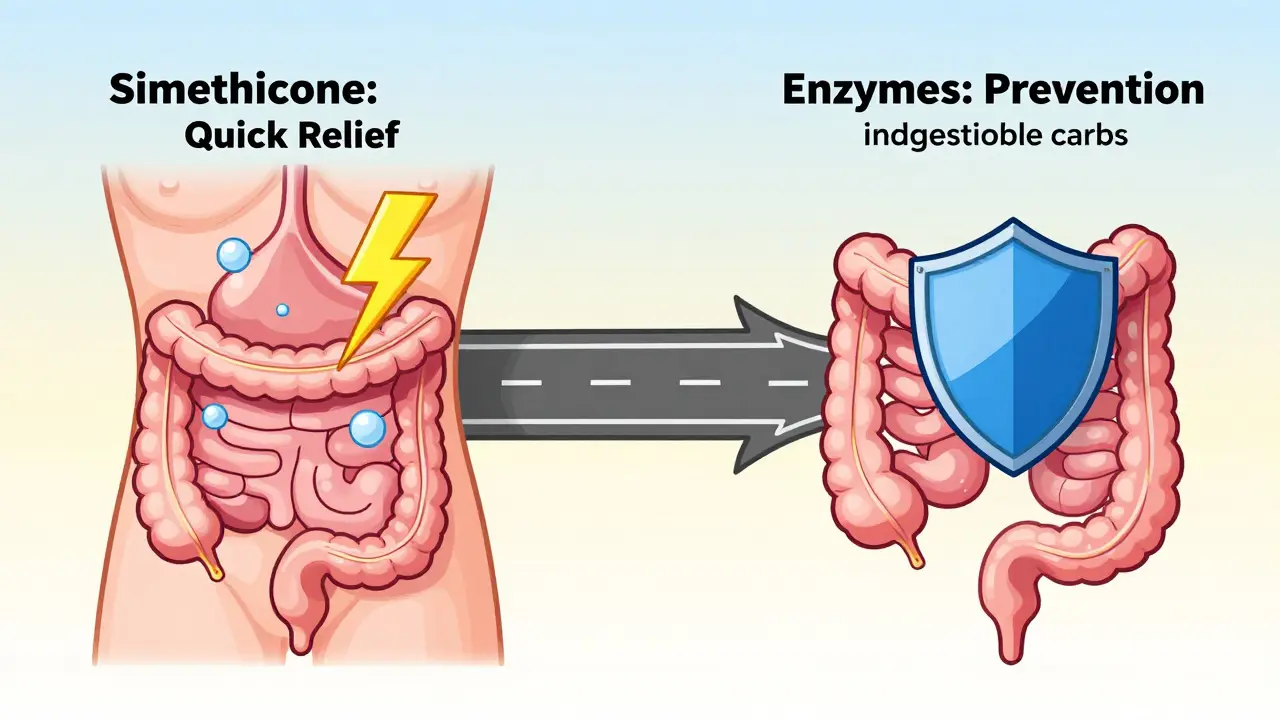
Let’s cut through the marketing. Simethicone is for symptom relief. Enzymes are for prevention.
Use simethicone when:
- You’re already bloated and need quick relief
- You don’t know what caused the gas (could be anything: stress, swallowing air, a new food)
- You’re traveling, eating out, or can’t control your meals
- You want something safe for daily use
Use enzymes when:
- You know exactly what triggers your gas (dairy, beans, cruciferous veggies)
- You can plan ahead and take the product before eating
- You’re trying to avoid symptoms long-term, not just fix them
Here’s what the data says:
| Feature | Simethicone | Enzyme Products (Lactase/Alpha-Galactosidase) |
|---|---|---|
| How it works | Breaks up gas bubbles | Breaks down indigestible carbs before fermentation |
| Speed of action | 15-30 minutes | Must be taken 5-10 minutes before eating |
| Best for | Acute bloating, unknown causes | Known dietary triggers (dairy, beans) |
| Prevents gas? | No | Yes, if taken correctly |
| Effectiveness rate | 73.5% for symptom relief | 85% for lactose; 45-78% for beans |
| Side effects | None | Rare (mild stomach upset if overdosed) |
| Cost (per 100 doses) | $12-$15 | $18-$22 |
Simethicone wins for convenience. Enzymes win for targeted prevention. Many people use both: Beano before a bean burrito, then Gas-X if they still feel bloated afterward.

Why Some People Say It Doesn’t Work
You’ve probably heard: “I took simethicone and it did nothing.” That’s not always a lie. In people with chronic bloating-like those with IBS or small intestinal bacterial overgrowth (SIBO)-simethicone often doesn’t help much. Why? Because the problem isn’t trapped gas bubbles. It’s inflammation, motility issues, or bacterial overgrowth. Simethicone doesn’t fix those.
Similarly, enzyme products can fail if you take them too late, don’t take enough, or eat a food they don’t cover. Beano won’t help with fructose malabsorption. Lactaid won’t help if you’re sensitive to casein, not lactose.
Real users on Reddit and Amazon say it best: “Simethicone is my emergency button.” “Beano is the only reason I can eat chili.” “I tried both. Now I use them together.”
What to Buy and How to Use It
For simethicone:
- Choose 125 mg capsules or chewables (Gas-X, Phazyme)
- Take 1 after meals or when bloating starts
- Don’t exceed 500 mg per day
- Chewable tablets must be chewed well-swallowing them whole won’t work
For enzymes:
- For dairy: Lactaid Regular Strength (9,000 FCC units) or generic
- For beans/veggies: Beano (450-1200 GalU per dose)
- Take before eating-no exceptions
- Start with the lowest dose. If it doesn’t work, try the next strength
Combination products (like Gas-Zyme) exist, but they’re pricier. Only buy them if you’ve tried both separately and need both. Otherwise, you’re paying for ingredients you don’t need.
When to Skip OTC and See a Doctor
OTC remedies are great for occasional discomfort. But if you’re experiencing:
- Bloating that lasts more than a few days
- Weight loss with gas
- Pain that’s not relieved by gas relief
- Changes in bowel habits (diarrhea, constipation, blood in stool)
Then it’s time to look deeper. Gas and bloating are symptoms-not diagnoses. Underlying issues like celiac disease, SIBO, or even colon cancer can mimic simple gas trouble. Don’t keep popping pills if your body’s screaming for answers.
Final Takeaway
Simethicone is your quick fix. Enzymes are your long-term shield. Neither cures the root cause, but both can make daily life bearable. Use simethicone when you’re already bloated. Use enzymes when you know what’s coming. And if you’re unsure? Start with simethicone-it’s safe, cheap, and fast. If that doesn’t help, then look at your diet. Sometimes, the best remedy isn’t in the bottle-it’s on your plate.
Can I take simethicone every day?
Yes. Simethicone is safe for daily use. The FDA allows up to 500 mg per day for adults. Most people only need 40-125 mg per dose, taken after meals or as needed. Long-term use doesn’t cause tolerance or side effects. But if you’re relying on it daily, it’s a sign your gas problem may need deeper investigation.
Do enzyme supplements work for everyone?
No. Lactase works well for people with lactose intolerance-about 85% of users see improvement. Alpha-galactosidase (Beano) is less reliable, working for 45-78% of users depending on the food and individual gut bacteria. Some people just don’t respond. If Beano doesn’t help after a few tries, it’s not worth the cost.
Is simethicone safe for kids and pregnant women?
Yes. Simethicone is non-absorbed and doesn’t enter the bloodstream. It’s used in infant drops (Mylicon) for colic and is considered safe during pregnancy. Always follow the dosing instructions for children-infant drops are 20 mg/mL and should be given as directed.
Can I use simethicone and enzymes together?
Absolutely. Many people do. Take Beano before a bean-heavy meal, and if bloating still happens, take simethicone afterward. There are no known interactions. In fact, combination products exist because this approach works well in real life.
Why does Beano cost so much more than Gas-X?
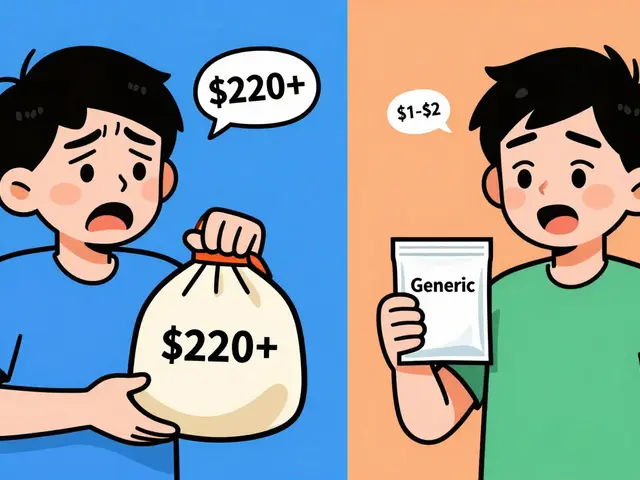
Enzymes are biological molecules-harder and more expensive to produce than synthetic simethicone. A 100-count bottle of Beano costs $18-$22. A 200-count bottle of Gas-X is $12-$15. Simethicone is cheaper to manufacture and has a longer shelf life. If you only need occasional relief, simethicone is more economical.
Do OTC gas remedies cure IBS?
No. IBS involves complex gut-brain interactions, motility issues, and sometimes bacterial imbalance. Simethicone may offer temporary relief from bloating, but it doesn’t fix the underlying cause. Enzymes won’t help unless your IBS is triggered by specific foods like lactose or FODMAPs. Long-term IBS management requires diet changes, stress reduction, and sometimes medical treatment-not just OTC pills.
OTC gas remedies are tools-not solutions. Use them wisely. Know what they can and can’t do. And remember: the best way to stop gas isn’t always in the medicine cabinet.


12 Comments
Okay but can we talk about how Beano is basically the wizard of the dinner table? 🧙♀️ I took it before my infamous black bean tacos last night and my stomach didn’t revolt. I mean, I’ve been eating beans since I was six and never once thought I’d be able to enjoy them without feeling like a balloon at a kid’s birthday party. Simethicone? Sure, it’s the emergency fire extinguisher. But Beano? That’s the fire prevention system. I’m convinced my colon sent me a thank-you note.
Also-why is it always so expensive? Like, I get it, enzymes are fancy biological molecules, but $22 for 100 doses? I could buy a whole damn sack of dried beans for that. Maybe I’ll start making my own from ground lentils and hope for the best. 🤷♀️
USA made simethicone cheap and it works 🇺🇸🔥 why are we paying for fancy enzyme nonsense? My grandma used baking soda and it worked better than all this corporate BS. Stop overcomplicating food. Eat less beans. Stop being weak. 💪
Let’s cut through the noise here: simethicone is a placebo with a side of air bubbles. It’s the ibuprofen of gas-doesn’t fix the root, just dulls the sensation. Meanwhile, enzymes are precision tools, but their efficacy is wildly heterogenous across populations. The 45–78% success rate for Beano? That’s not a failure-it’s a microbiome lottery. Your gut flora is your personal ecosystem. You’re not broken if it doesn’t work. You’re just not the right host for that particular enzyme cocktail.
Also, cost per dose is misleading. Simethicone’s $0.07/dose sounds great until you realize you’re taking it 4x a day because your diet hasn’t changed. Enzymes? One dose per meal. One. You’re not paying for magic. You’re paying for metabolic intervention. And if you’re eating beans daily? That’s not a problem to mask. That’s a dietary pattern to audit.
It is both fascinating and lamentable that our modern pharmacopeia has reduced the complex, multifaceted phenomenon of gastrointestinal distress to two discrete, commodified interventions: one mechanical, one enzymatic. The human digestive system, an intricate symphony of peristalsis, microbial symbiosis, and enzymatic cascade, is being treated as a malfunctioning pipe system. We are not merely vessels for undigested oligosaccharides; we are ecological entities. To reduce bloating to a matter of choosing between surface-tension modifiers and glycoside hydrolases is to ignore the deeper anthropological and physiological context of alimentation.
Perhaps the real remedy lies not in a pill, but in the reclamation of ancestral foodways-fermented legumes, properly soaked grains, mindful mastication. These are not mere anecdotes; they are evolved strategies honed over millennia. The pill is a Band-Aid on a hemorrhage.
Just wanted to say thank you for this breakdown. I’ve been taking Gas-X after every meal for years because I thought it was helping. Turns out I’m lactose intolerant and didn’t even know it. Started using Lactaid before dairy and now I can eat ice cream without feeling like I swallowed a bowling ball. 🙌 I didn’t realize enzymes were meant to be taken BEFORE-not after. That was my whole mistake.
Also-simethicone is legit my emergency button too. If I accidentally eat something sketchy? One pill and I’m chill in 20 mins. So yeah. Both. Always both.
bro i took beano before chili and still exploded like a pressure cooker 😭 i think my gut hates me. simethicone just makes me feel like i’m holding in a ghost. not helpful. maybe i just need to stop eating food??
The assertion that simethicone is universally effective is scientifically untenable. Clinical trials demonstrate variable outcomes based on gastric transit time and colonic microbiota composition. Furthermore, the claim that enzyme efficacy is solely dependent on timing ignores epigenetic modulation of digestive enzyme expression. In populations with high dietary fiber intake, such as in India, alpha-galactosidase demonstrates reduced bioavailability due to competitive binding with complex polysaccharides. Thus, the efficacy of Beano in Western populations cannot be extrapolated globally.
Moreover, the cost analysis presented is misleading. When adjusted for dosage per gram of indigestible carbohydrate, enzyme therapy demonstrates superior cost-efficiency. The perception of high cost arises from marketing strategies targeting Western consumerism, not pharmacoeconomic reality.
Bro this is actually life-changing info! 🙏 I used to think gas was just part of being alive. Now I know I can eat my favorite dal and roti without feeling like I’m about to launch into orbit. Beano before meals? Game changer. Simethicone after? Bonus round. I’m telling my whole family. We’re all getting a bottle. India’s got the spices, but America’s got the science. Win-win!
OMG I JUST REALIZED I’VE BEEN TAKING BEANO AFTER EATING 😭 I’M SUCH A DUMBASS. I’VE BEEN DOING THIS FOR YEARS AND NEVER KNEW IT HAD TO BE BEFORE. NO WONDER IT DIDN’T WORK. I’M BUYING A NEW BOTTLE TONIGHT. THANK YOU FOR THIS. I’M SO EMBARRASSED BUT ALSO SO GRATEFUL. 💕
People pay $20 for a pill to eat beans? That’s not science, that’s weakness. Real Americans don’t need enzymes. We eat beans, we fart, we move on. You want to avoid bloating? Eat less. Stop coddling your gut. This is why America’s getting soft. Simethicone? Fine. But enzymes? That’s just surrendering to dietary cowardice.
Love this breakdown. I’ve been using both for years and never realized how perfectly they complement each other. Like, I take Beano before my weekly lentil stew, and if I still feel a little full later? Simethicone. It’s like having a backup plan for your gut. Also-yes, it’s totally safe to take simethicone daily. My mom’s been on it for 15 years and she’s 78 and feels great. No side effects. Just peace.
And if you’re still bloated after all this? Maybe it’s not the food. Maybe it’s stress. Or sleep. Or water. But that’s a whole other thread.
So I tried Beano after reading this. Took it 5 mins before dal. Didn’t work. Took it 10 mins before. Still didn’t work. Took it 15 mins before. Nothing. I think my body just doesn’t like the idea of enzymes. So I just take Gas-X. It’s not perfect. But it’s my friend. 🤝