
When someone you love stops breathing because of an overdose, every second counts. Most overdoses happen at home - not in hospitals or clinics. That means the person who might save a life isn’t a paramedic. It’s you. Or your partner. Or your parent, sibling, or teenager. Teaching family members to recognize overdose symptoms isn’t about fear. It’s about preparedness. And it works. Studies show that when families know what to look for and how to act, overdose deaths drop by up to 40%.
What Overdose Looks Like - Not Just for Opioids
People often think of overdose as someone slumped over, unresponsive, with blue lips. That’s true for opioid overdoses - the most common type - but it’s not the whole picture. Families need to know how overdoses differ across drugs.For opioids like heroin, fentanyl, or prescription painkillers, watch for the opioid triad:
- Unresponsiveness - They don’t wake up when you shout their name or rub your knuckles hard on their sternum (chest bone). If they don’t respond, it’s not just sleeping.
- Slow or stopped breathing - Fewer than one breath every five seconds. Or no breathing at all. This is the most dangerous sign.
- Cyanosis - Lips, fingernails, or skin turning blue or purple. But this isn’t always obvious. On darker skin, look for grayish or ashen tones instead.
Other signs include:
- Limp body - Like a rag doll. No muscle tone.
- Clammy or pale skin - Cold to the touch, even if the room is warm.
- Gurgling or snoring sounds - Not sleep. This is the "death rattle" - fluid building up in the throat because breathing has stopped.
For stimulants like cocaine, meth, or even MDMA, overdose looks different:
- Body temperature over 104°F (40°C) - Skin feels hot, flushed, or sweaty.
- Seizures or convulsions
- Chest pain, racing heartbeat, or fainting
- Extreme confusion, aggression, or hallucinations
Here’s the key difference between being high and overdosing: Someone who is just high will respond to physical stimulation. If you shake them, yell, or rub their sternum and they stir - they’re not overdosing. If they don’t respond at all? That’s an emergency.
How to Teach It - No Lectures, Just Practice
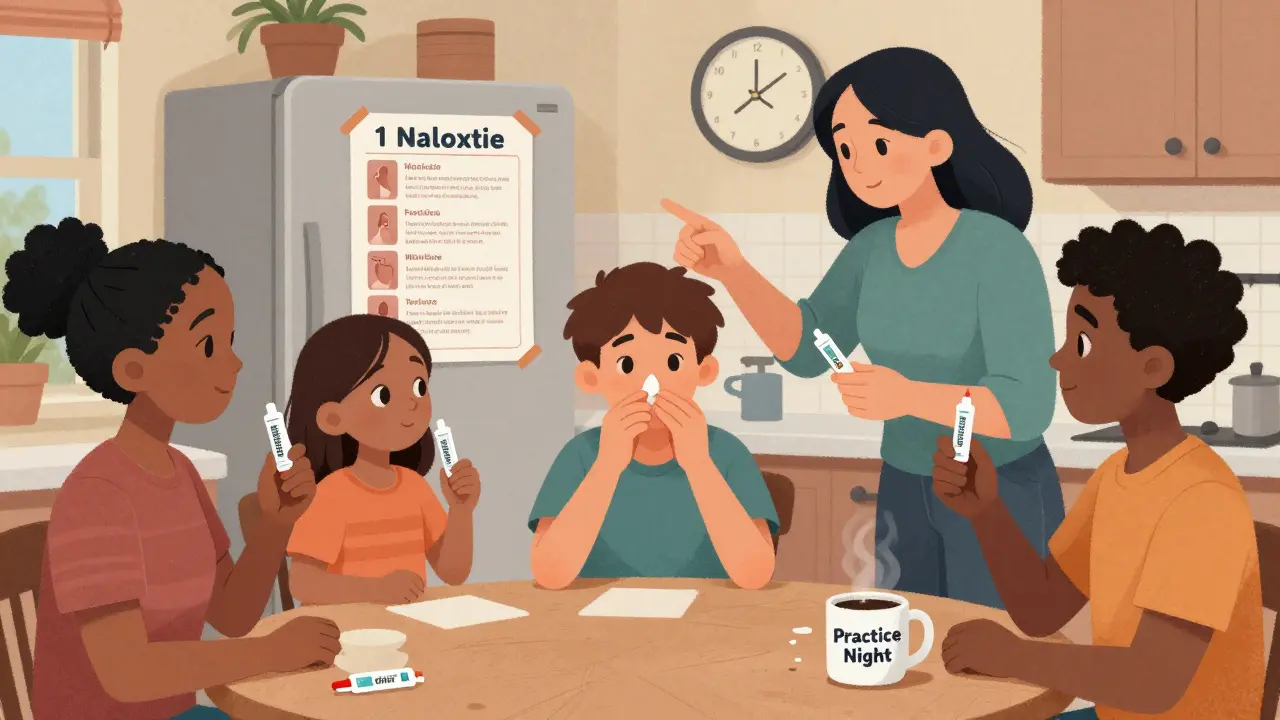
You can’t just hand someone a pamphlet and expect them to remember. Research shows families retain 73% more information when they practice - not just listen.Use the Recognize-Respond-Revive method:
- Recognize - Go through the signs together. Use photos or videos showing real people with different skin tones. Don’t skip this. A 2022 study found that programs teaching skin tone differences reduced misidentification by 63%.
- Respond - Practice calling 911. Say it out loud: "I think someone is overdosing. I need an ambulance now." Then, practice positioning them on their side - the recovery position. This keeps their airway open.
- Revive - Use a training naloxone kit. These are cheap ($35), non-functional, and safe. Practice the steps: remove the cap, place the nozzle in one nostril, press the plunger hard. Repeat if needed. Time yourself. Aim to do it in under 30 seconds.
Set up a 15-minute drill once a week. Use scenario cards: "Your son is slumped on the couch, not breathing. His lips are gray. What do you do?" Make it real. The more you practice, the less panic you’ll feel when it matters.
Why Naloxone (Narcan) Is Non-Negotiable
Naloxone isn’t a magic cure. But it can reverse an opioid overdose - if given fast. The CDC says 98% of opioid overdoses can be reversed if naloxone is given within 4 minutes of stopped breathing.Every family that has someone using opioids - even occasionally - should have at least two naloxone kits. Why two? Because sometimes one dose isn’t enough. Fentanyl is so strong, it often takes two.
You don’t need a prescription in most places. In 31 U.S. states and many other countries, pharmacies hand out naloxone over the counter. Ask your local pharmacy. If they don’t have it, call your health department. Most offer free kits.
Keep one kit in your car. One in your wallet. One at home. And make sure everyone knows where they are. A 2023 survey found that 87% of families who used naloxone successfully had it within arm’s reach.

What to Do After Giving Naloxone
Giving naloxone isn’t the end. It’s the start.Naloxone wears off in 30-90 minutes. Opioids can stay in the system longer. So even if they wake up, they can go back into overdose. That’s why calling 911 is mandatory.
Stay with them. Keep them on their side. Talk to them. Even if they’re confused or angry, keep talking. Reassure them. Tell them help is coming.
Don’t leave them alone. Don’t assume they’re fine. Emergency responders need to know what you did - and what drugs were involved. Write it down if you can: "I gave two doses of naloxone. They responded after the second. They were using fentanyl."
Overcoming Emotional Barriers
Many families avoid this training because it feels too real. They worry it’ll "jinx" their loved one. Or they’re afraid of confronting addiction.That’s normal. But here’s what the data says: 92% of people who were scared to train later said they were glad they did. One father on Reddit wrote: "After practicing three times with the training kit, I recognized my son’s overdose immediately. I reversed it with Narcan before EMS arrived."
Start small. Don’t try to teach everything at once. Pick one sign - like unresponsiveness. Practice that for a week. Then add breathing. Then skin tone. Then naloxone.
Use language that reduces shame. Say: "This isn’t about blame. It’s about having a plan. Just like we have a fire drill."

What You Need to Get Started
You don’t need a medical degree. You need these three things:- Training naloxone kits - Available free or cheap from health departments or harm reduction organizations. Look for "training" or "practice" versions.
- Scenario cards - Make your own. Write real situations your family might face.
- A skin tone guide - Download one from the California Department of Public Health or Overdose Lifeline. Print it. Tape it to the fridge.
Set a time. 45 minutes. One evening. No distractions. Phones off. Everyone there. Even the teenager. Even the one who says "I don’t use drugs."
Real Impact - Stories Behind the Numbers
In Georgia, 87 family members trained in a county program later used their skills to respond to real overdoses. All 87 people survived.In New Zealand, a similar program in Dunedin saw 12 families reverse overdoses at home in 2023 - all because they practiced.
These aren’t miracles. They’re results. When families know what to do, they become the first line of defense. And in overdose prevention, the first line is the only one that matters.
Can I give naloxone to someone who isn’t overdosing?
Yes. Naloxone is safe. It only works if opioids are in the system. If someone didn’t take opioids, naloxone does nothing. There’s no risk of harm from giving it unnecessarily. It’s better to give it and be wrong than to wait and be too late.
What if I’m not sure it’s an overdose?
Call 911 anyway. Emergency responders are trained to handle uncertainty. It’s better to overreact than underreact. Every second counts. If they’re unresponsive and not breathing normally, treat it like an overdose. Give naloxone. Start rescue breathing. Don’t wait for a second opinion.
Do I need to be certified to carry naloxone?
No. In most places, including New Zealand and 31 U.S. states, you can get naloxone without a prescription or certification. Some states require training to receive it for free, but you don’t need formal certification to use it. Training is about confidence - not legality.
How often should I practice with my family?
Once a month is ideal. Even 10 minutes of review keeps skills sharp. Memory fades. Stress makes us forget. Regular practice turns panic into instinct. Think of it like CPR training - you don’t wait until someone’s dying to learn.
Can I train kids or teens?
Yes. Teens as young as 12 can learn to recognize overdose signs and use naloxone. Many programs now include youth-focused training. In fact, teens are often more confident and quicker to act than adults. Make it age-appropriate - use simple language, role-play, and avoid fear-based messaging.

8 Comments
Let’s be real - this whole thing is just government brainwashing to make people feel safe while they keep pushing harm reduction like it’s a religion. You want to save lives? Stop enabling drug use. Lock up dealers. Stop handing out free Narcan like candy. This isn’t ‘preparedness’ - it’s surrender. If your kid’s using fentanyl, maybe the problem isn’t that you didn’t drill them on breathing signs - maybe it’s that you let them grow up in a society that tells them drugs are no big deal. Time to stop coddling addicts and start holding them accountable.
I appreciate the practical approach, but I keep thinking - why are we only talking about overdose response and not prevention? If we’re teaching families to recognize symptoms, shouldn’t we also be teaching them how to have those hard conversations before it gets to this point? There’s something deeply human here - not just medical. It’s about connection. Love. Presence. I’ve seen families who practiced this drill and still lost someone, because the emotional wound was already too deep. Maybe the real breakthrough isn’t in the nostril spray - it’s in the silence before the crisis. The ‘I’m here’ moments. The ones we never train for.
Oh wow. Another feel-good, liberal pamphlet on how to save the junkies. Let me guess - next you’ll be teaching toddlers how to use a bong safely? I’ve got news for you - Narcan doesn’t fix broken homes. It doesn’t fix trauma. It doesn’t fix the fact that 70% of overdoses happen because someone was told ‘it’s just one time’ and then got fentanyl-laced glitter. This isn’t ‘preparedness.’ This is normalization. You’re turning a tragedy into a checklist. And honestly? That’s disrespectful to the dead. If you really cared, you’d be out there fighting addiction - not handing out toy syringes and calling it ‘empowerment.’
Thank you for writing this. 💙 I’ve been scared to talk about this with my family… but after reading this, I printed out the skin tone guide and taped it to our fridge next to the fire escape plan. We did our first 10-minute drill last night - just me, my sister, and my 14-year-old brother. He didn’t roll his eyes once. We practiced the sternum rub. He said, ‘That’s kinda like when we play zombie apocalypse.’ I cried. Not because I’m sad - because I finally feel like we’re not helpless. We’re not just waiting. We’re learning. And that’s enough for now. 🙏
omg this is so needed i wish more people knew this like i had no idea naloxone was free at pharmacies and i thought you needed a prescription like wow i just got two from my local clinic and my mom is like ok we are doing this every sunday now lmao but seriously thank you for making it simple and not scary like its not about drugs its about being ready like a fire extinguisher but for people 💕
Narcan works. Period. No debate. Two doses. 30 seconds. Side position. Call 911. Done. Stop overthinking. Stop waiting for ‘the right moment.’ If they’re unresponsive and not breathing - act. Your hesitation kills. Training isn’t optional. It’s biological imperative. Your family’s life depends on muscle memory. Drill it. Like CPR. Like AED. Like knowing where the gas shutoff is. This isn’t activism. It’s basic human competence.
Interesting piece. I’ve been involved in a similar initiative here in the UK - we call it ‘The Front Door Response.’ The most powerful moment wasn’t the training - it was when a grandmother said, ‘I didn’t know my grandson was using. But now I know how to save him.’ That’s the quiet revolution, isn’t it? Not the kits. Not the drills. But the moment shame turns into action. We’re not fixing addiction. We’re just giving people a chance to survive it. And sometimes, that’s all you need.
Oh honey, this is just *adorable*. 🥰 I love how you made it so ‘accessible’ - like, who doesn’t have a fridge? And a teenager? And a ‘training kit’? 😘 But let’s be real - if you’re not a middle-class white family with health insurance and a stable home, this whole thing is a luxury. I’ve seen rural clinics where they don’t even have gloves. And yet here we are, teaching people to ‘practice’ like it’s a yoga class. Maybe we should start by fixing the system instead of teaching people how to patch it. Just saying. 🙃