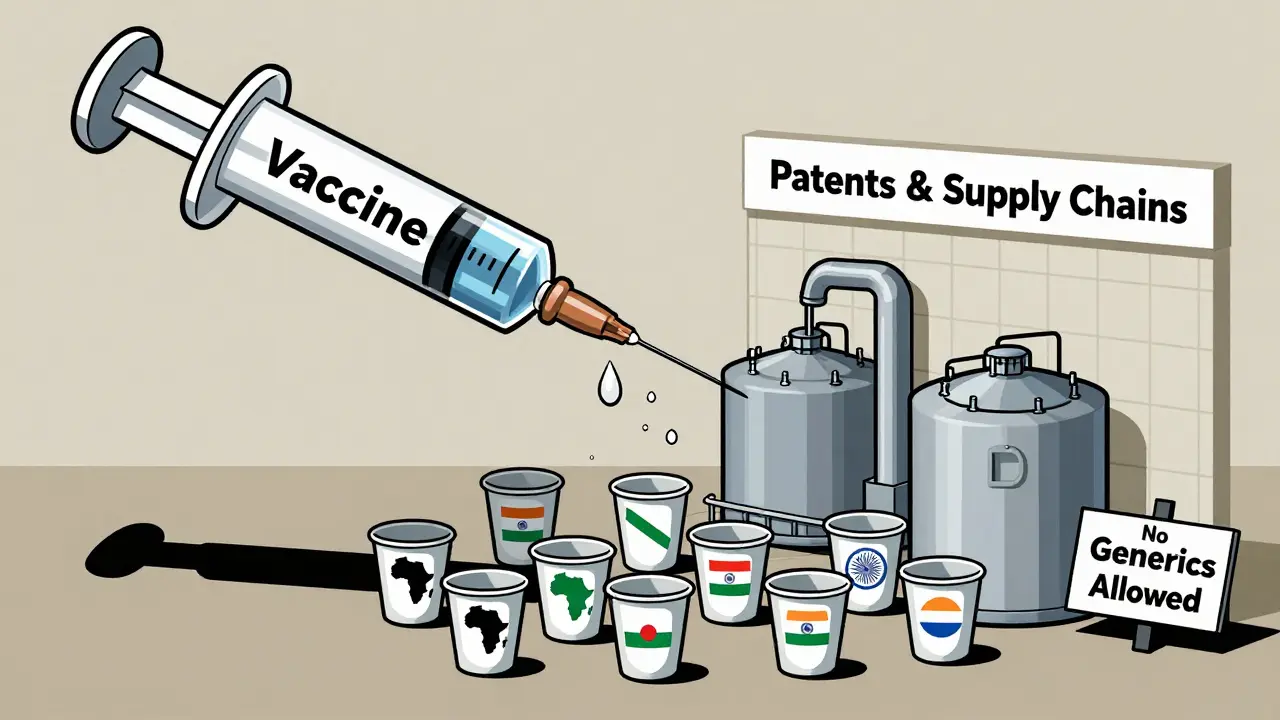

There’s no such thing as a vaccine generic-not in the way you think. When you buy a generic pill for high blood pressure or antibiotics, you expect the same active ingredient, same effect, same low price. But vaccines? They don’t work that way. And that’s not a technical glitch. It’s a structural reality that’s been hiding in plain sight for decades. The world thought the pandemic would change everything. It didn’t. It just made the gap wider.
Why You Can’t Just Copy a Vaccine
Generic drugs are simple compared to vaccines. A pill like metformin has one chemical structure. Copy it, test it, approve it. Done. Vaccines are alive. They’re made from viruses, proteins, or genetic code grown in living cells. Even if you get the exact recipe, you can’t just replicate it in a different factory. The process matters as much as the formula.
Take mRNA vaccines like Pfizer and Moderna. They need lipid nanoparticles-tiny fat bubbles that carry the genetic instructions into your cells. There are only five or seven companies in the world that can make those nanoparticles at scale. If you don’t have access to them, you can’t make the vaccine. Even if you get the blueprint from the original maker, you still need specialized equipment, ultra-cold storage, and technicians trained for years. That’s why the WHO’s mRNA tech transfer hub in South Africa, set up in 2021 with support from BioNTech, didn’t produce its first dose until September 2023-and even then, it was only a fraction of what’s needed.
There’s no Abbreviated New Drug Application (ANDA) for vaccines. No shortcut. No bioequivalence test. Every vaccine needs a full new license, full clinical trials, full validation. That means years and hundreds of millions of dollars before a single dose is made. That’s not innovation. That’s a barrier.
Who Makes the World’s Vaccines?
India makes more vaccines than any other country. By volume, it supplies 60% of global vaccine production. It’s the source of 90% of the measles vaccine the WHO distributes. It’s the reason millions of children in Africa and Southeast Asia get DPT and BCG shots at all. The Serum Institute of India alone produces 1.5 billion doses a year across 11 facilities.
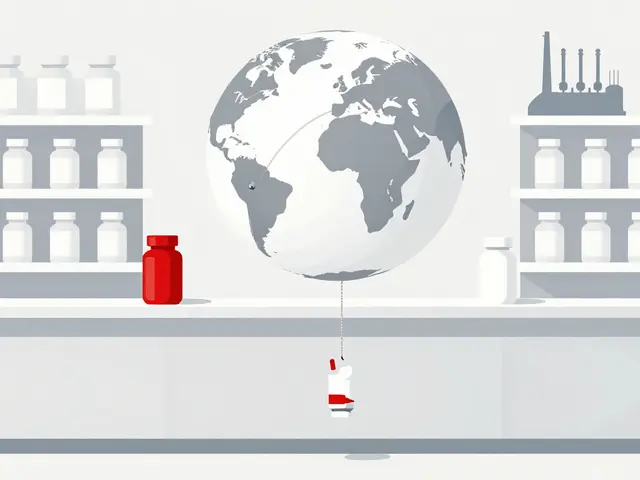
But here’s the twist: India doesn’t make vaccines for itself. It makes them for the world. And when India’s own COVID-19 surge hit in early 2021, it stopped exports. The world lost half its supply overnight. That’s not a failure of planning. That’s how the system works. Production is global. Access is local. And when a crisis hits, national needs win.
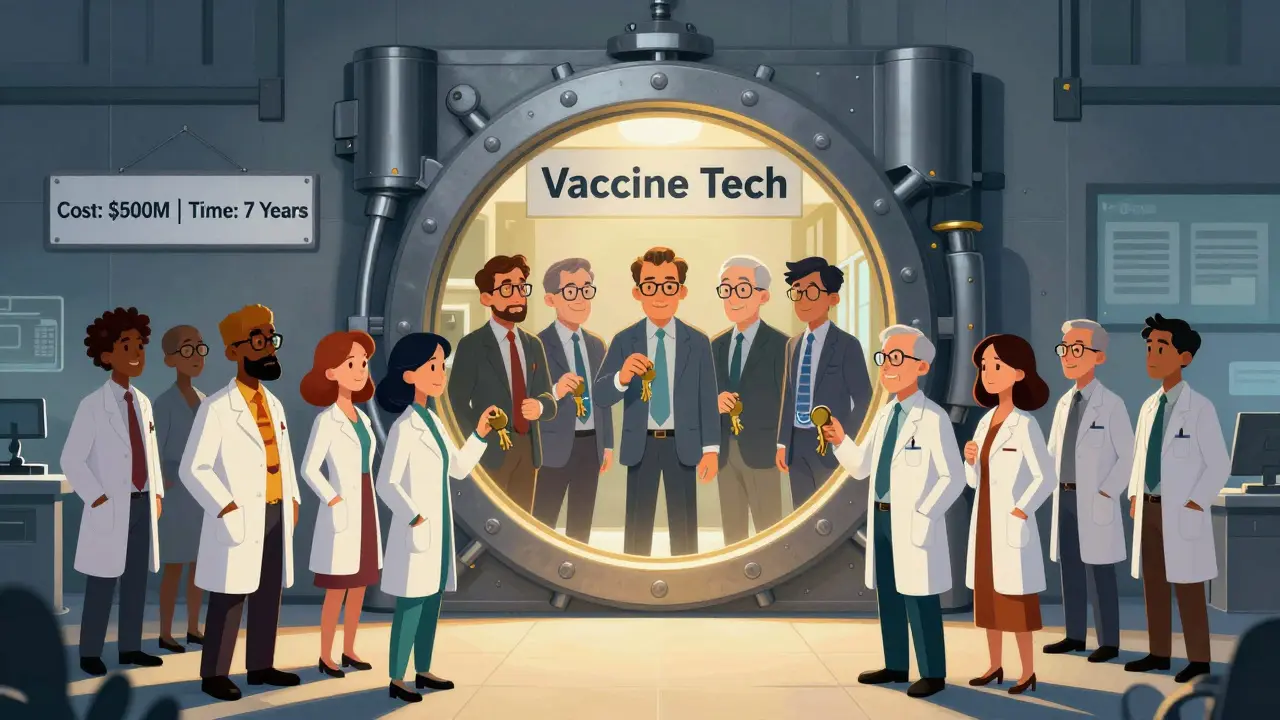
The top five companies-Pfizer, Moderna, GSK, Merck, and Sanofi-control about 70% of the global vaccine market. They’re not just big. They’re the only ones with the capital, infrastructure, and regulatory relationships to keep producing. New players? They’re trying. But the cost to build a single vaccine manufacturing line? $500 million. The time? Five to seven years. That’s not a startup problem. It’s a global system problem.
The Price Isn’t Just High-It’s Designed That Way
Generic drugs can drop 90% in price after a few competitors enter. Vaccines? Not even close. Gavi, the global vaccine alliance, still pays over $10 per dose for the pneumococcal vaccine in low-income countries. The same vaccine costs $15-$20 in rich countries. That’s not inflation. That’s pricing strategy.
India’s Serum Institute made the AstraZeneca vaccine for $3-$4 per dose. That’s cheaper than most generic pills. But even that price barely covered costs. The real money isn’t in the dose. It’s in the monopoly. Companies hold patents. They control supply. And they know no one else can step in fast enough to force competition.
Compare that to insulin, where generics have cut prices by 80% in the U.S. after new manufacturers entered. No such pressure exists for vaccines. There’s no market for volume. There’s only a market for scarcity.
The Geography of Inequality
Africa produces 1% of its own vaccines. It imports 99%. That’s not because Africans can’t make them. It’s because no one invested in building the capacity. The African Union estimates it would take $4 billion and 10 years to reach 60% self-sufficiency by 2040. That’s a plan. But plans don’t fill syringes.
During the pandemic, 83% of the 1.1 million COVID-19 doses delivered to Africa through COVAX went to just 10 countries. The other 23 African nations vaccinated less than 2% of their people. In the Democratic Republic of Congo, health workers got doses with expiration dates two weeks away-no cold chain, no way to use them. That’s not a logistics failure. That’s a design flaw.
Meanwhile, the U.S. FDA announced in 2025 that only 9% of active pharmaceutical ingredient (API) manufacturers are based in the U.S., while 44% are in India and 22% in China. The U.S. is trying to bring some production home-not for equity, but for security. It’s not about saving lives. It’s about protecting supply chains.
The Fragile Supply Chain No One Talks About
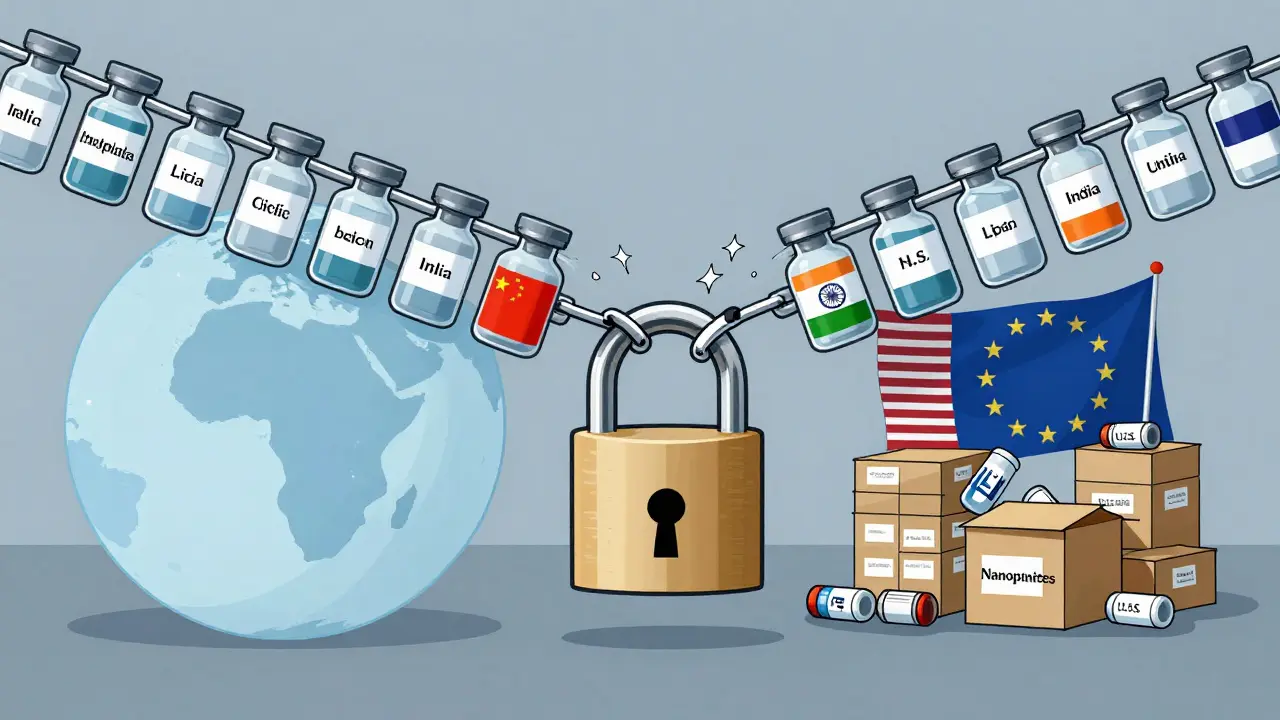
It’s not just about factories. It’s about what goes into them. India imports 70% of its vaccine raw materials from China. When the U.S. restricted exports of critical lipids during India’s second wave, global production dropped by 50%. One country. One policy. Half the world’s supply gone.
There are no backup suppliers. No stockpiles. No redundancy. Just a chain of single points of failure. One factory shutdown. One export ban. One shipping delay. And entire regions are left with nothing.
That’s why experts like Dr. Lucica Ditiu of the Stop TB Partnership say there are no reliable substitutes for API supplies. No spare capacity. No emergency reserves. And if a country can build a vaccine plant, it’s more likely to use it for its own people than for aid.
What’s Actually Changing?
There are glimmers. The WHO’s mRNA hub in South Africa is producing. A few new factories are being built in Indonesia, Senegal, and Brazil. But none of them come close to filling the gap. By 2025, low- and middle-income countries will still be 70% dependent on imports, according to Gavi.
The real change won’t come from patents being waived. It won’t come from goodwill. It comes from money. From governments and donors investing in infrastructure, not just donations. From training local technicians, not just sending syringes. From building supply chains that don’t rely on a single supplier in China or a single factory in India.
There’s no magic fix. No shortcut. No generic version of a vaccine. But there is a way forward: build capacity where it’s needed. Not as a charity. Not as a backup. As a core part of the global health system.
What’s Next?
If you think vaccine equity is about fair distribution, you’re half right. The real issue is about who gets to make them. Until low-income countries can build, test, and export vaccines without depending on a handful of foreign suppliers, the cycle will repeat. Next pandemic. Next shortage. Next emergency. Next excuse.
The tools exist. The knowledge exists. What’s missing is the commitment to treat vaccine manufacturing like any other essential infrastructure-like roads, water, or electricity. Not as a luxury. Not as a favor. As a right.
Why can’t we just make generic vaccines like we do with pills?
Vaccines are biologics, not chemicals. They’re made from living cells, proteins, or genetic material, and require complex, multi-step manufacturing processes that can’t be replicated like a chemical compound. Unlike generic drugs, vaccines can’t prove "bioequivalence" through simple tests. Each one needs a full clinical trial and regulatory approval, making true generics impossible under current systems.
Does India produce generic vaccines?
India doesn’t produce "generic" vaccines in the traditional sense, but it is the world’s largest vaccine manufacturer by volume. It produces branded vaccines under license (like AstraZeneca’s COVID-19 shot) and WHO-prequalified vaccines like DPT and measles. These aren’t generics-they’re original formulations made under license-but they’re produced at far lower prices than in wealthy countries, making them critical for global access.
Why do low-income countries still import 99% of their vaccines?
Most low-income countries lack the capital, infrastructure, and technical expertise to build vaccine manufacturing facilities. Building a single plant costs $200-$500 million and takes 5-7 years. Supply chains for critical materials are controlled by just a few global suppliers. Without investment and technology transfer, these countries remain dependent on imports-even when they have the workforce and capacity to eventually produce vaccines locally.
Can technology transfer solve vaccine access problems?
Technology transfer helps-but only if it includes more than just blueprints. The WHO’s mRNA hub in South Africa received technical help from BioNTech but still took 18 months to start production due to delays in sourcing specialized equipment and raw materials. Real transfer requires not just knowledge, but access to supply chains, trained personnel, regulatory support, and long-term funding.
Is the U.S. or EU doing anything to fix this?
Yes-but not for equity. The U.S. FDA launched a pilot in 2025 to speed up approval for generic drugs made domestically, partly because 91% of API manufacturing is overseas. The EU is pushing for "strategic autonomy" in health supplies. These efforts aim to reduce dependency on China and India for medicines, not to help Africa or South Asia build vaccine capacity. The focus is on national security, not global access.
What would it take to make vaccine production truly global?
It would require coordinated investment: $4-$6 billion in regional manufacturing hubs, training 10,000+ local technicians, creating regional supply chains for raw materials, and establishing pre-approved regulatory pathways for vaccines made outside the U.S. and EU. It also means abandoning the idea that vaccines are a market good and treating them as public infrastructure-like water or electricity. That’s not just expensive. It’s politically hard. But without it, the next pandemic will look the same as the last.




8 Comments
So let me get this straight-we’re telling developing countries they can’t make vaccines because it’s too hard, but we’ll happily sell them at $10/dose while hoarding the tech? 🤦♀️ This isn’t a supply issue. It’s a greed issue.
India makes 60% of the world’s vaccines and you act like we’re just some dumb factory farm? We built this system with sweat and sleepless nights while the West patented everything and called it innovation. Now you want us to share the secrets? Fine. But first, stop acting like your patents are sacred and our labor is invisible.
I’ve worked in global health for 15 years. Let me tell you something: it’s not about the science. It’s about who gets to sit at the table. The WHO hub in South Africa? Brilliant. But it’s still begging for pipettes. Meanwhile, Pfizer’s CEO just got a bonus for 'global expansion'. We’re not failing because we lack knowledge. We’re failing because we lack the will to share power.
The analogy to generic drugs is misleading. Vaccines are not chemical compounds; they are complex biological products requiring precise manufacturing conditions. While the barrier to entry is high, the solution isn’t just patent waivers-it’s sustained investment in technical capacity, regulatory harmonization, and supply chain resilience. India’s success proves it’s possible-but only with long-term commitment, not charity.
Wow. Just... wow. So we’re supposed to believe that after 20 years of global health campaigns, the only reason Africa doesn’t make vaccines is because nobody ‘invested’? Really? That’s your excuse? You think they didn’t try? Or maybe-just maybe-they were told for decades that they ‘weren’t ready’? And now you’re surprised?
Build the factories. Train the people. Fund the supply chains. Stop talking. Start doing.
You say India stopped exports during COVID. But you ignore that the West blocked export of critical lipids and raw materials to India. Who really caused the bottleneck? The manufacturer? Or the nations that weaponized supply chains? Don’t blame the producer for the theft of inputs.
I’ve seen this play out in rural clinics. We send syringes. We send cold boxes. We send hope. But we never send the people who know how to fix the machines, or the money to train the next generation. It’s not about vaccines. It’s about dignity. Let them build. Let them lead. Let them be the ones who decide what 'access' means. Not us.