

When a gout flare hits, it doesn’t ask for permission. One minute you’re fine, the next your big toe feels like it’s been crushed in a vise. The pain is sharp, sudden, and often unbearable. And if you’ve been through it once, you know the fear that comes with the next one. The good news? There are three main drugs that can stop a flare in its tracks: colchicine, NSAIDs, and steroids. But which one’s right for you? It’s not about picking the strongest drug - it’s about picking the safest one for your body.
How Fast Do You Need to Act?
Time matters. A lot. If you wait more than 24 hours after the pain starts, the drugs work less well. Rheumatologists say: start treatment within 24 hours - ideally within 24 seconds of noticing the swelling. That’s not hyperbole. The inflammation in gout spikes fast, and the earlier you hit it, the faster the pain fades. Delaying treatment doesn’t just mean more pain - it can mean a longer flare, more joint damage, and more time off work.
That’s why having a plan matters. If you’ve had gout before, keep your meds handy. Don’t wait until you’re in agony to call your doctor. Get your prescription filled before the next flare hits.
NSAIDs: The Go-To, But With Big Risks
NSAIDs - like naproxen, ibuprofen, and indomethacin - are the most common first choice for gout flares. They work by reducing inflammation and pain. For best results, you need high doses: 500 mg of naproxen twice a day, 800 mg of ibuprofen three times a day, or 50 mg of indomethacin three times a day. That’s not a casual dose. That’s a medical dose.
Only three NSAIDs - indomethacin, naproxen, and sulindac - are officially FDA-approved for gout. But in practice, doctors use any NSAID at full anti-inflammatory strength. The problem? These drugs are hard on your body.
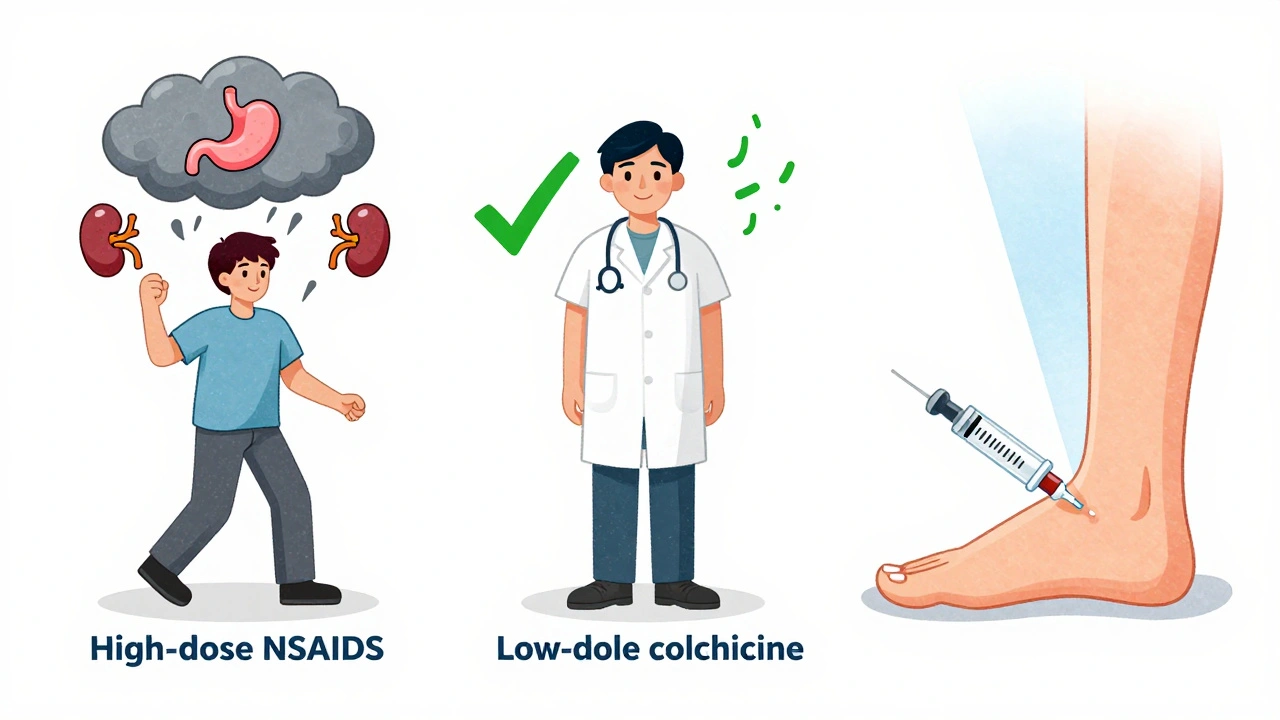
They can wreck your stomach - causing ulcers or bleeding. They can hurt your kidneys, especially if you’re already dealing with high blood pressure or diabetes. And they raise your risk of heart attacks and strokes. That’s a big deal because most people with gout are over 50, and many have these same conditions.
One study found that naproxen and low-dose colchicine gave the same pain relief over seven days - but naproxen caused more side effects. So even the "safest" NSAID isn’t safe for everyone. If you’ve ever had a stomach ulcer, take blood thinners, or have kidney disease, NSAIDs might be a bad idea.
Colchicine: The Old Favorite, Now Done Right
Colchicine has been used for gout for centuries. But for years, doctors gave high doses - up to 4.8 mg over six hours. That meant vomiting, diarrhea, and sometimes worse. Now we know better.
Current guidelines recommend a low dose: 1.8 mg total, taken as 0.6 mg every hour for three hours. That’s it. Studies show this gives the same pain relief as the old high-dose method - but with 60% fewer side effects. No more vomiting. No more days spent on the toilet.
But colchicine has its own danger zone: toxicity. It’s easy to overdose, especially if you have kidney or liver problems. Even a small mistake can lead to muscle damage (rhabdomyolysis), seizures, or even death. If you’re on statins, or take certain antibiotics or heart meds, colchicine can interact badly.
It’s also slow to work. You might not feel relief for 12 to 24 hours. So if you’re in screaming pain right now, colchicine alone might not be enough. But if you’re young, healthy, and your stomach’s fine, it’s a solid option - especially if you can’t take NSAIDs.
Steroids: The Underused Powerhouse
Steroids - like prednisone - are often overlooked. But here’s the truth: they’re just as good as NSAIDs at reducing pain, and often safer. A major review of six studies with over 800 patients found no difference in pain relief between steroids and NSAIDs. Both helped about 73% of people cut their pain in half. Placebo? Only 27%.
But steroids don’t wreck your stomach. They don’t hurt your kidneys the way NSAIDs do. And unlike colchicine, they’re not toxic at slightly higher doses. That’s why many doctors now say: if you’re over 65, have high blood pressure, kidney trouble, or a history of ulcers - start with steroids.
Standard dose? 40 to 60 mg of prednisone on day one, then slowly drop the dose over 10 to 14 days. Tapering is critical. Stop too fast, and your flare can come back worse than before.
There’s another trick: if only one joint is swollen - say, your big toe or knee - get a steroid injection right into the joint. No pills. No side effects. Just targeted relief. It’s fast, effective, and avoids the whole system. Many patients don’t even need oral meds after that.
One catch: steroids can spike your blood sugar. If you’re diabetic, your doctor will monitor you closely. But a short 10-day course? Usually fine. The risk of a flare coming back is far worse than a few days of higher glucose.
Who Gets What? A Quick Guide
There’s no universal rule. But here’s how most doctors decide:
- Healthy, under 60, no stomach or kidney issues? NSAIDs (naproxen or ibuprofen) are fine.
- Over 65, on blood pressure meds, or have kidney trouble? Start with oral steroids or a joint injection.
- Have a history of stomach ulcers or take blood thinners? Skip NSAIDs. Go with colchicine (low dose) or steroids.
- Only one joint is swollen? Ask about a steroid injection. It’s the cleanest option.
- Got diabetes? Steroids are okay - just watch your blood sugar. Colchicine is safer than NSAIDs here.
- On statins or certain antibiotics? Avoid colchicine. NSAIDs or steroids are better.
And here’s the real secret: sometimes, you need more than one. If one drug doesn’t fully control the pain, adding a low dose of colchicine to a steroid can work wonders. Or using a steroid injection with oral NSAIDs. Doctors do this more often than you think - but only when needed.
What About Prevention?
Stopping a flare is one thing. Stopping the next one? That’s the real game. If you’re on medication to lower your uric acid - like allopurinol or febuxostat - you’re still at risk for flares in the first few months. That’s because as crystals dissolve, they trigger inflammation.
That’s why guidelines say: if you’re starting uric acid-lowering therapy, you need to take a preventive drug for at least three months. If you’ve had tophi (those lumpy deposits under your skin), you need six months.
Most people use low-dose colchicine (0.6 mg once or twice a day) for this. NSAIDs or low-dose steroids work too. But you don’t want to be stuck on high doses forever. Prevention is about balance - just enough to stop flares, not enough to cause harm.
Bottom Line: It’s Not About the Drug. It’s About You.
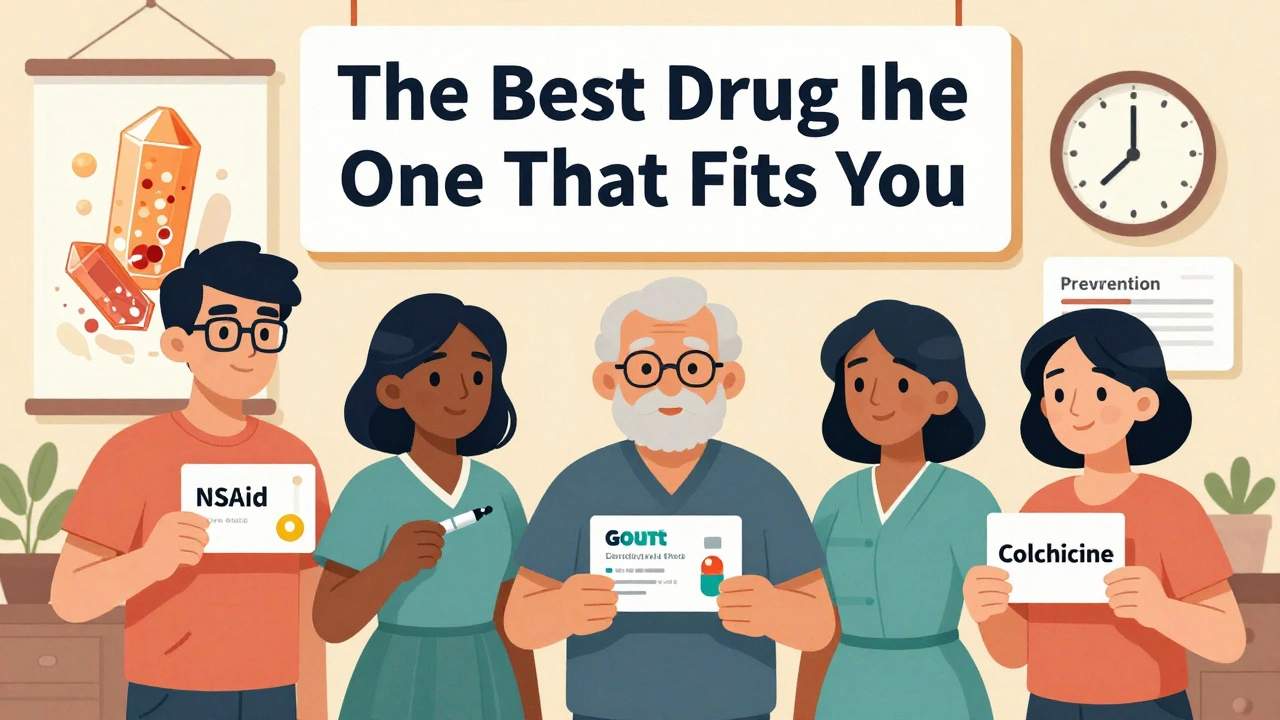
There’s no single best drug for gout. The best drug is the one that works for your body - and doesn’t hurt it. NSAIDs? Great if your stomach and kidneys are healthy. Colchicine? Good if you’re careful about interactions. Steroids? Often the smartest choice for older patients or those with other health problems.
What you need most isn’t a new miracle drug. It’s a plan. Know your triggers. Keep your meds ready. Talk to your doctor about your full medical history - not just your gout. And don’t wait until the pain is unbearable to act. Start early. Start smart.
15 Comments
Been there, done that. Got the swollen toe and the 3am panic. Took ibuprofen once, ended up in the ER with a stomach bleed. Now I keep prednisone in my medicine cabinet. No joke, 40mg on day one and I’m walking by day three. Just don’t skip the taper - I learned that the hard way.
NSAIDs = my worst enemy 😫 I used to crush naproxen like candy… now I get steroid shots and it’s like magic 🤫✨ #goutwarrior
Colchicine at low dose changed my life. Used to throw up every time I took it. Now I do 0.6mg three times over an hour and I’m good. No more bathroom jail. Pro tip: take it with food if your stomach’s sensitive. Also - if you’re on statins, talk to your pharmacist before even thinking about it. I’ve seen too many people get hospitalized from drug combos.
And yeah, steroids aren’t perfect but for older folks or those with kidney issues? Way safer than NSAIDs. My dad’s 72, diabetic, on blood pressure meds - he gets a joint injection and calls it a day. No pills. No drama.
Also, if you’ve got tophi? Don’t wait. Start uric acid meds early and prep with colchicine for at least six months. The flares get worse if you don’t. Trust me, I’ve been on both sides.
And please stop waiting till you’re screaming to call your doctor. Keep your meds ready. I keep my 0.6mg pills in my wallet. Literally. Flare hits? Pop one. Don’t overthink it.
Also - if you’re Indian like me? Watch your diet. Red meat, beer, shellfish? Yeah. That’s not a coincidence. I cut all three and my flares dropped 80%. Medication helps, but lifestyle? That’s the real MVP.
The data is clear: low-dose colchicine (1.8mg total) is as effective as high-dose with significantly fewer GI side effects. NSAIDs carry a 2-4x higher risk of GI bleeding in patients over 60. Steroids show non-inferiority to NSAIDs in pain reduction with lower renal toxicity. For patients on statins, colchicine interactions are dose-dependent and can lead to rhabdomyolysis. Always check CYP3A4 and P-gp interactions. A single steroid injection into an affected joint provides localized anti-inflammatory effects without systemic exposure. Prevention with low-dose colchicine during initiation of uric acid-lowering therapy reduces flare frequency by 50-70% over three months. This is evidence-based, not anecdotal.
LET ME TELL YOU ABOUT THE TIME I IGNORED THE 24-HOUR WINDOW. I thought I’d "wait it out." I didn’t. I spent three days curled up on the bathroom floor, whispering to my toe like it was a wounded puppy. I swear to god, if I’d taken that 0.6mg colchicine right when I felt the first twinge - I’d have been at work by lunch. Now I keep a little pill organizer next to my coffee maker. First sign of swelling? BAM. Pill. No questions. No pride. Just survival.
And steroids? Don’t let the word scare you. It’s not steroids like bodybuilders use. It’s a 10-day course to put out a fire. My rheumatologist calls it a "fire extinguisher." I call it my superhero cape. I got a shot in my knee last month. Felt better in 6 hours. No stomach pain. No kidney stress. Just peace.
Also - if you’re on antibiotics? Stop. Talking. To. Strangers. About colchicine. That combo is a death trap. I lost a buddy to it. Don’t be that guy.
So let me get this straight - we’ve got a disease caused by our ancestors’ love of meat and beer, and now we’re supposed to take pills to fix it? Classic capitalism. First they give us the poison, then they sell us the antidote. And don’t even get me started on "steroids." Like, sure, it works. But what’s next? Are we gonna inject ourselves with pure willpower next?
Also, why is everyone so obsessed with timing? "Start within 24 seconds?!" That’s not medicine, that’s a spy movie. I miss the days when you just drank some whiskey and hoped for the best.
Still… I’ll take the steroid shot. At least it doesn’t make me vomit. And I don’t have to remember to take pills. I’m lazy. I’m 43. I’m tired. Just give me the needle.
Colchicine low dose is effective. Steroids avoid GI risk. NSAIDs contraindicated in renal disease. Injection preferred for monoarticular flare. Prevention with colchicine recommended. Plan ahead. Do not delay treatment.
Okay but has anyone actually tested if ice and vodka works better than all this? I mean, I’ve been doing both since 2018 and I’ve never had to take a pill. Also, the article says "steroids are safer" but what about the moon phases? I read on a forum that gout flares spike during full moons and steroids don’t fix that. Also, my cousin’s dog got gout and they cured it with turmeric. So… what’s the real science here? Or is this just Big Pharma selling us pills we don’t need?
For patients with chronic kidney disease, NSAIDs are absolutely contraindicated. Colchicine requires dose adjustment for eGFR below 60. Steroids remain the safest oral option in this population. Joint aspiration with corticosteroid injection is underutilized and should be considered first-line for monoarticular flares. Prophylaxis with low-dose colchicine (0.6 mg once or twice daily) during initiation of uric acid-lowering therapy reduces flare incidence by up to 75%. Always confirm drug interactions - especially with macrolides, azoles, and statins. This is not opinion. This is clinical guideline.
Why do Americans always think they’re the only ones with gout? In India, they just eat curry and call it a day. You people are so obsessed with pills and injections. I’ve had gout for 15 years. I’ve never taken a steroid. I just drink lemon water and cry quietly. Also, NSAIDs are just corporate poison. You’re being manipulated. Wake up.
And why does everyone assume you’re over 65 if you have gout? I’m 39. I work out. I eat clean. But apparently, my genetics are just too American to handle a beer. So now I’m supposed to be on lifelong meds? No thanks. I’ll just keep my toe in ice and pretend I’m a Viking.
Wow. Another article that makes me feel like a burden. I’m not lazy, I’m not stupid, I just have gout. But apparently, I’m supposed to be a medical expert now? Keep track of doses, interactions, timing, injections, uric acid levels, and now I have to remember to taper steroids? I’m just trying to walk without screaming. Why does everything have to be so complicated? I just want to be normal. But I guess that’s too much to ask.
My grandma had gout and she never took any of this stuff. She just drank cherry juice and slept it off. And guess what? She lived to 92. I’m not saying meds are bad - I’m just saying maybe we’re overcomplicating it. I keep low-dose colchicine on hand and I drink tart cherry juice every morning. I haven’t had a flare in 18 months. No injections. No scary pills. Just simple stuff. Sometimes the old ways are the best ways.
Also - if you’re diabetic? Don’t panic about steroids. Ten days isn’t going to ruin your health. But skipping treatment? That will. I’ve seen it. It’s not worth the risk.
And hey - if you’re reading this and you’re scared? You’re not alone. We’re all just trying to get through the next flare without losing our minds. You got this.
Bro i had gout in mumbai last year and i took ibuprofen and my stomach went full rebellion 🤮 i was like a ghost for 3 days. then my cousin who’s a nurse said try colchicine but like the new low dose thing and OMG it was like a miracle. no puking. no cramps. just chill. also i started drinking lime water with honey every morning and my flares are way less now. i dont even take meds anymore unless its super bad. and yeah steroid shot? yes please. i got one in my ankle and i was dancing at a wedding 2 days later 😎
also dont wait till you scream. i learned that the hard way. keep the pills next to your toothbrush. i keep mine in my sock drawer. weird? maybe. but it works.
and to the people saying steroids are bad? bro they’re not magic potions. its 10 days. your body knows what to do. dont let fear stop you from feeling normal again.
I used to be the guy who waited until I couldn’t walk. Then I got a steroid injection. It was the best 10 minutes of my life. No pain. No pills. Just quiet. Now I keep a bottle of colchicine in my car. Flare hits? Pop one. Drive to the clinic. Get the shot. Done. I don’t overthink it anymore. My doctor says I’m a model patient. I just say I’m tired of being in pain.
Also - if you’re on statins? Don’t even look at colchicine. I know someone who did. He ended up in ICU. Not worth it.
And yeah, NSAIDs are fine if you’re young and healthy. But if you’re over 50? Play it safe. Steroids are the quiet hero here.
This is all nonsense. Gout is just a sign you’re eating too much. Stop blaming the drugs. Stop blaming your genes. Stop taking pills. Just stop eating meat. Drink water. Walk. Simple. Done. Why do we need all this science? We used to live without it. We can live without it now.