

Imagine spending two billion dollars and a decade of research only to have a competitor swoop in and sell your product for pennies the moment your patent expires. For pharmaceutical companies, the "patent cliff" is a terrifying reality. But while most people think a patent is the only shield a drug company has, the truth is far more complex. There is a secondary layer of protection called market exclusivity extensions that can keep generics off the shelf long after the original patent has technically died.
These extensions aren't just bonuses; they are strategic tools. In some cases, they allow a company to maintain a monopoly for 20 years or more post-approval. The goal is to reward the massive risk of drug development, but critics argue it's often used to keep prices high by gaming the system. If you've ever wondered why some life-saving medications stay expensive for decades, the answer usually lies in these regulatory loopholes and stacking strategies.
The Foundation: The Hatch-Waxman Act
To understand how this works, we have to go back to 1984. Before then, there was a huge tension between the need to reward innovators and the need for affordable generics. The Hatch-Waxman Act is the landmark U.S. law that balanced these interests by allowing generic drugs to enter the market more easily while providing patent extensions to innovators to compensate for regulatory delays .
The logic was simple: the FDA takes years to approve a drug. If a patent lasts 20 years from the filing date, but the FDA spends seven of those years reviewing the drug, the company only gets 13 years of actual sales. Hatch-Waxman tried to fix this by allowing a few extra years of protection. However, the system has evolved. Today, nearly 91% of drugs that get these extensions manage to keep their monopolies way beyond the intended 14-year post-approval window.
Patent Extensions vs. Regulatory Exclusivity
It is a common mistake to use "patent" and "exclusivity" interchangeably, but they are different animals. A patent is granted by a patent office (like the USPTO) based on whether an invention is new and useful. Regulatory exclusivity is granted by a health agency (like the FDA or EMA) based on the data provided during the approval process.
In the US, you have Patent Term Extension (PTE), which is strictly capped at five years to make up for FDA delays. But then there's the regulatory side. For example, a New Chemical Entity (NCE) exclusivity provides 5 years of protection regardless of patents. If the drug is for a rare disease, it might get Orphan Drug exclusivity, which lasts 7 years in the US and up to 12 years in the EU.
| Mechanism | United States (FDA/USPTO) | European Union (EMA/EC) |
|---|---|---|
| Max Patent-Related Extension | Up to 14 years post-approval (PTE) | Up to 15 years post-approval (SPC) |
| Orphan Drug Protection | 7 years | 10 years (up to 12 with pediatric data) |
| Pediatric Bonus | 6 months added to existing terms | Included in SPC or PUMA (8+2 years) |
| New Indication Protection | 3 years (requires new formulation) | Data exclusivity (8+2+1 structure) |
The Art of 'Stacking' and Evergreening
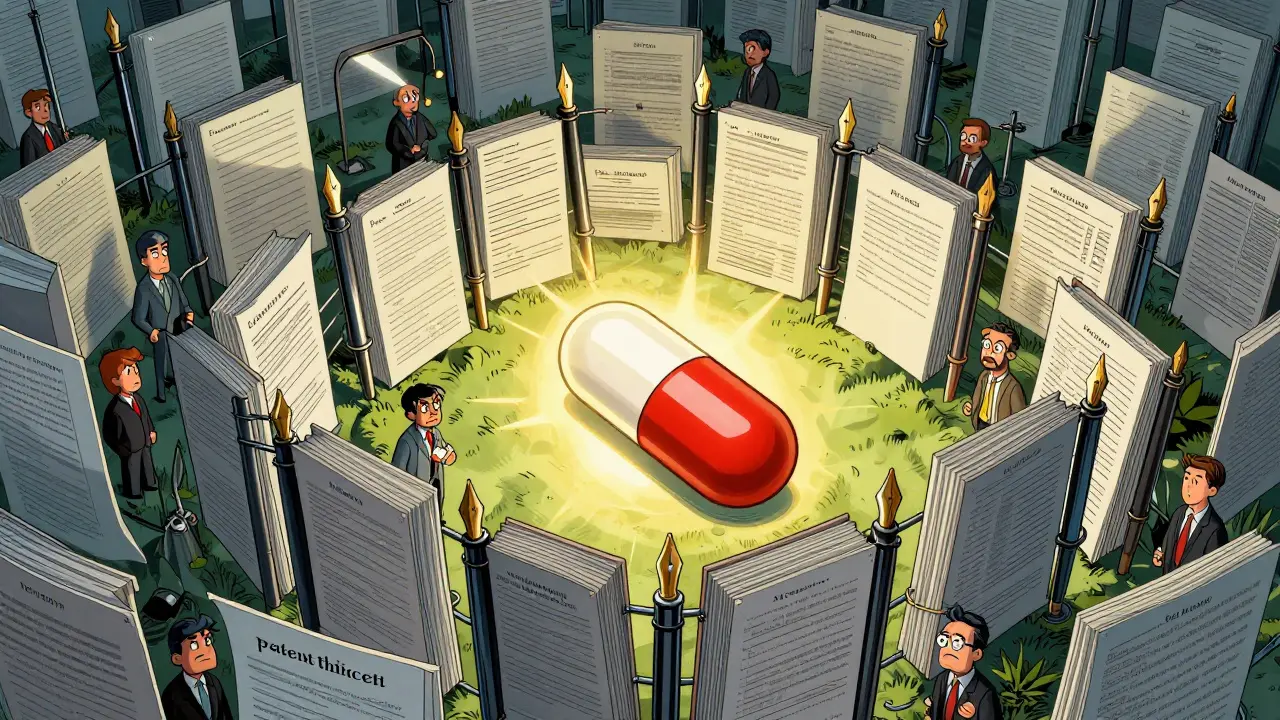
If you're a patent attorney for a Big Pharma firm, your goal isn't just to get one patent; it's to build a "patent thicket." This is where the real money is made. By filing dozens of secondary patents-covering things like the way a drug is dissolved, the specific dose, or a slightly different chemical salt-companies can create a wall of protection that generic makers can't easily climb.
Take the drug tazarotene as a concrete example. It didn't just have one core patent; it accumulated 48 additional patents to keep competitors away. This is often called "evergreening." A company might release a version of a drug, and then just as the patent is ending, they launch a "new and improved" version (product hopping) and push doctors to switch patients to the new one. By the time the generic for the old version arrives, nobody is using it anymore.
Strategic stacking is where these timelines get interesting. A company might combine a core patent, a PTE extension, a 7-year Orphan Drug exclusivity, and a 6-month pediatric extension. By layering these, they can push the "patent cliff" back by years. For some blockbuster drugs, this has extended effective exclusivity to over 20 years post-approval.
The Economic Tug-of-War
Why does this matter to the average person? Because it's incredibly expensive. A study in the JAMA Health Forum found that for just four top-selling drugs, these extensions resulted in $3.5 billion in extra spending over two years because generics were blocked from entering the market. In 2022, branded drugs accounted for 78% of US pharmaceutical revenue despite only making up 10% of prescriptions. That's a huge concentration of wealth driven by these exclusivity rules.
On the flip side, the industry argues that without these protections, innovation would stop. Developing a new drug costs an average of $2.3 billion. Venture capitalists are unlikely to fund a biotech startup if they know the product will be genericized in a few short years. In fact, nearly 68% of biotech startups say these extensions are the only reason they can secure the funding needed to start research in the first place.

Navigating the Regulatory Minefield
Getting these extensions isn't as simple as filling out a form. It requires a dedicated team of specialists. Major pharma companies often employ 15 to 25 experts just to manage the exclusivity of a single blockbuster drug. The strategy starts long before the drug hits the market.
Some companies use a delayed filing strategy. Instead of filing a patent the moment they find a promising molecule, they wait until after Phase II clinical trials. This ensures that the 20-year patent clock starts later, aligning better with the actual date the drug enters the market. If they're chasing a new indication for an existing drug, they have to prove clinical superiority-it's not enough to just change the label; they have to show the drug actually works better for the new use to get that 3-year exclusivity window.
The Future of Market Protection
Regulators are starting to push back. The Federal Trade Commission (FTC) has recently targeted "product hopping" as a potential violation of antitrust laws. They're arguing that switching patients to a slightly modified drug just to extend a monopoly is anticompetitive. Meanwhile, the European Commission is proposing changes to the Supplemental Protection Certificate (SPC), which is the EU's version of a patent extension, to ensure it rewards genuine innovation rather than minor tweaks.
We're seeing a shift. The FDA is tightening the rules on what qualifies for new indication exclusivity, demanding more substantial evidence of benefit. Despite this, analysts predict that the average effective exclusivity period will actually increase to about 16.3 years by 2028. The battle between the need for affordable medicine and the need for innovation incentives is only getting more intense.
What is the difference between a patent and regulatory exclusivity?
A patent is a legal right granted by the government (e.g., USPTO) that prevents others from making or selling an invention for a set period (usually 20 years). Regulatory exclusivity is a period of time granted by a health agency (e.g., FDA) during which the agency will not approve a generic version of the drug, regardless of whether a patent exists. You can have both at the same time, and they can overlap or extend one another.
How long does Orphan Drug exclusivity actually last?
In the United States, Orphan Drug exclusivity lasts for 7 years. In the European Union, the standard is 10 years, but this can be extended to 12 years if the company fulfills specific pediatric investigation requirements.
What is "evergreening" in the pharma industry?
Evergreening is the strategy of filing multiple secondary patents on a drug-such as new dosages, formulations, or methods of administration-to extend the period of market exclusivity beyond the expiration of the original core patent. This effectively delays generic competition.
Can a company get more than one type of exclusivity for a single drug?
Yes. This is known as "stacking." A company can combine NCE exclusivity, Orphan Drug exclusivity, and pediatric extensions. For example, adding a 6-month pediatric extension to an existing 7-year orphan drug period pushes the market entry for generics further back.
Does the Hatch-Waxman Act still matter today?
Absolutely. It created the framework for the modern generic drug industry and the current system of patent term restorations. While companies have found ways to stretch the limits of the Act, it remains the primary legal structure for balancing innovation and competition in the US.