
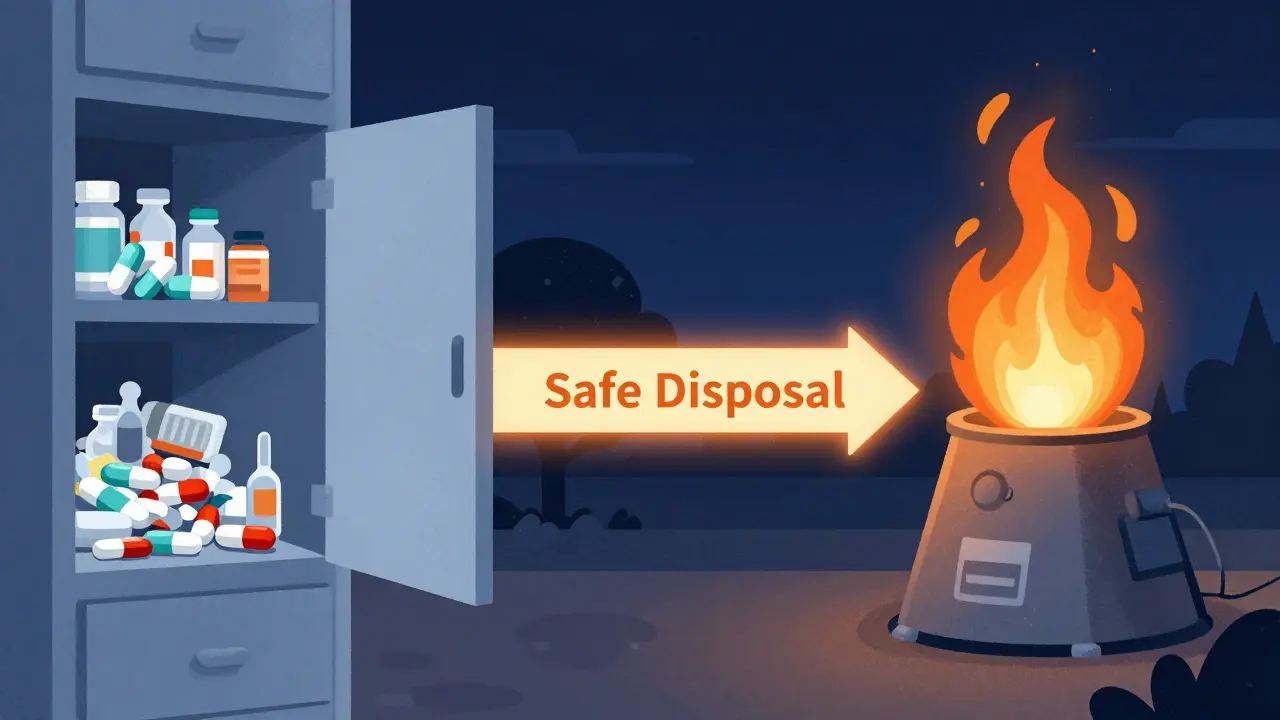
Every year, millions of unused prescription drugs sit in medicine cabinets across America-old painkillers, leftover antibiotics, expired antidepressants. Many people don’t know what to do with them. Flushing them down the toilet? Throwing them in the trash? Those are common, but dangerous choices. That’s where National Prescription Drug Take-Back Days come in. These events are the easiest, safest, and most effective way to get rid of unwanted medications without risking harm to your family, your community, or the environment.
What Exactly Happens on Take-Back Day?
National Prescription Drug Take-Back Day is run by the U.S. Drug Enforcement Administration (DEA) and happens twice a year-once in April and once in October. The next one is scheduled for October 25, 2025, from 10 a.m. to 2 p.m. local time. You don’t need an appointment. You don’t need to show ID. You don’t even need to answer questions. Just show up with your unused meds, hand them over, and walk away.
Collection sites are set up in places you already know: local police stations, hospital pharmacies, fire departments, and some retail pharmacies. In 2025, there will be over 4,500 sites across the country. In April 2025 alone, Americans dropped off 620,321 pounds of prescription drugs-over 300 tons. Since the program started in 2010, more than 19.8 million pounds have been collected.
What Can You Bring?
Not everything goes in the collection bin. Here’s what’s accepted:
- Pills and capsules
- Transdermal patches (like fentanyl or nicotine patches)
- Liquid medications (in original sealed containers)
- Over-the-counter drugs (if mixed with prescription meds)
Here’s what you cannot bring:
- Syringes, needles, or sharps (they’re a safety hazard)
- Illicit drugs (like heroin or cocaine)
- Controlled substances from outside the U.S.
- Chemicals, inhalers, or aerosols
If you have needles or sharps, many hospitals and pharmacies offer separate sharps disposal programs. Call ahead to find out where. For liquids, make sure they’re still in their original bottles with the label intact. No loose cups or open containers.
Why Does This Matter?
It’s not just about cleaning out your cabinet. It’s about saving lives.
According to the National Survey on Drug Use and Health, 57.9% of people who misuse prescription drugs get them from friends or family-often from unsecured medicine cabinets. Teens, visitors, or even pets can accidentally-or intentionally-take what’s left over. In 2024, over 8 million Americans misused pain relievers. Many of those pills came from homes.
Improper disposal also hurts the environment. Flushing drugs sends chemicals into water systems. Throwing them in the trash means they can end up in landfills, leaching into soil and groundwater. The DEA’s program ensures all collected drugs are incinerated under strict environmental standards, preventing contamination.
And the results speak for themselves. Since the program began, opioid-related overdose deaths have dropped by 27% since 2020, according to the Partnership to End Addiction. While not the only factor, experts agree that reducing access to unused prescriptions plays a major role.
What to Expect When You Arrive
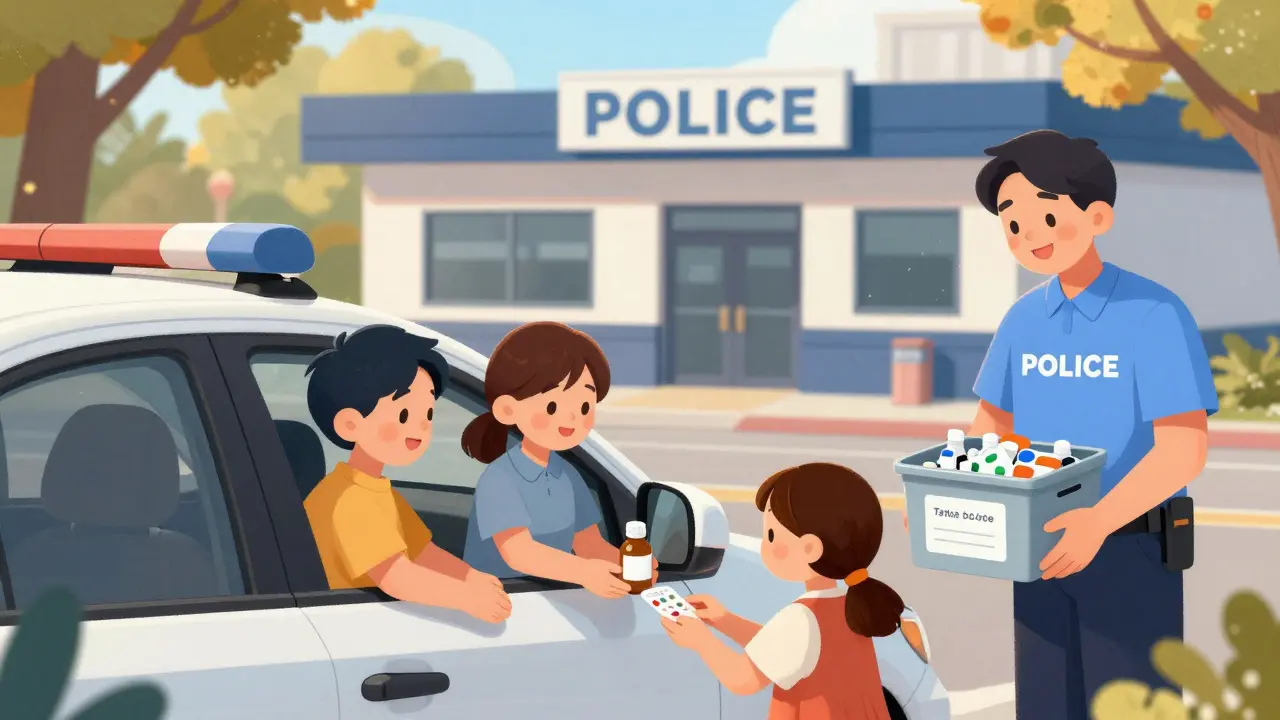
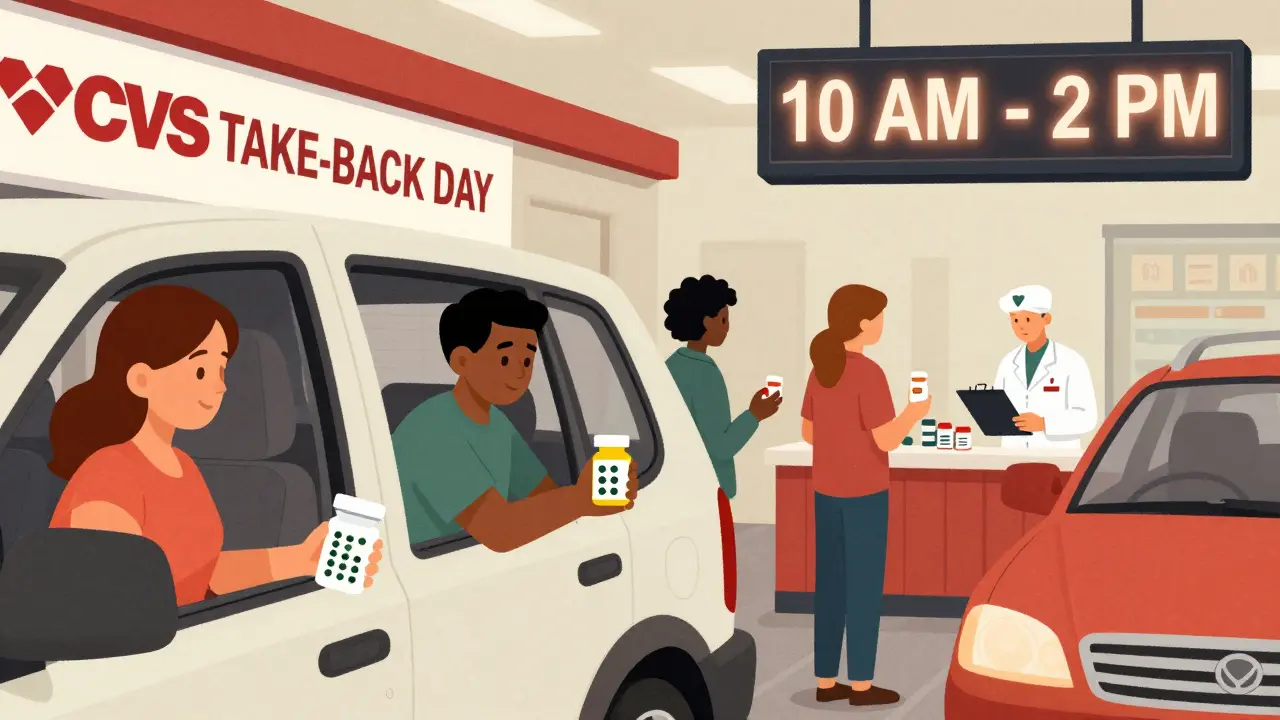
It’s simple. You drive up, roll down your window, or walk up to a table. A law enforcement officer or trained volunteer will hand you a box or bag. You drop in your meds. They check the container to make sure it’s not a prohibited item. That’s it. No forms. No questions. No waiting in line.
Most sites are set up like a drive-thru. You can stay in your car. If you’re on foot, there’s usually a short line, but it moves fast. The whole process takes less than two minutes. People report feeling relieved afterward-not just because they’re getting rid of something dangerous, but because they’re doing the right thing.
Some sites, like those run by University Hospitals in Ohio, offer extra help. They have nurses or pharmacists on hand to answer questions about medication safety, proper storage, or how to talk to aging parents about their pill bottles. These sites see 37% higher participation than ones that just collect.
What If You Miss the Date?
You don’t have to wait six months. There are over 14,000 permanent collection sites across the U.S. These are usually located in pharmacies, hospitals, or police stations. You can drop off meds anytime during business hours. The DEA maintains a searchable map on takebackday.dea.gov and through the “Dispose My Meds” app (used by over 340,000 people).
Some pharmacies now have permanent drop boxes inside their stores. Walgreens and CVS have installed kiosks in over 1,200 locations as of August 2025. These are locked, secure, and monitored 24/7. You can use them any day of the year.
But here’s the catch: permanent sites don’t always get the same level of public attention as Take-Back Day. That’s why the biannual events are so powerful-they create a national moment of awareness. They remind people that this isn’t just about convenience. It’s about responsibility.
Why Don’t More People Use It?
Despite the success, only about 19% of unused medications are properly disposed of, according to a 2024 survey by the American Society of Addiction Medicine. Why?
- Lack of awareness (28% of people didn’t know the event was happening)
- Location (rural areas average just one site per 50,000 people)
- Hours (only 4 hours on one day-hard for working parents or shift workers)
- Confusion (people aren’t sure what’s allowed or where to go)
The DEA is working on fixes. In 2025, they launched 120 mobile collection units to reach communities more than 25 miles from a site. They’re also testing a new system that would prompt patients with a reminder to dispose of unused meds when they pick up a new prescription-through electronic health records. Pilot programs with Epic Systems are underway in 12 hospital networks.
What’s Next?
The program’s future looks strong. Congress has kept funding at $2.4 million annually through 2025. More pharmacies are installing permanent kiosks. Rural outreach is expanding. The goal? To get that disposal rate above 50%.
But change starts with you. If you’ve got old pills sitting in your bathroom cabinet, don’t wait. Mark October 25, 2025 on your calendar. Or find your nearest permanent drop-off site today. One bottle, one day, one act-could prevent a tragedy.
Can I drop off someone else’s prescription drugs?
Yes. You can bring medications belonging to family members, friends, or even deceased loved ones. No identification is required. The program is designed to be anonymous and non-judgmental. Whether it’s your teen’s leftover painkillers or your parent’s old blood pressure pills, you’re doing the right thing by turning them in.
What happens to the drugs after I drop them off?
All collected medications are securely transported to authorized incineration facilities. The DEA requires that disposal follows strict federal environmental and safety standards. The drugs are burned at high temperatures to ensure complete destruction-no recycling, no landfill, no chance of diversion. This is the only method approved by the DEA for controlled substances.
Can I dispose of expired OTC medications like ibuprofen or allergy pills?
Yes. While the program primarily targets prescription drugs, you can also drop off over-the-counter medications like ibuprofen, antihistamines, or cough syrup-as long as they’re in sealed containers. Many people don’t realize that OTC drugs can be just as dangerous if misused or taken by children. Including them in the take-back helps reduce accidental poisonings.
Are there any costs involved?
No. The service is completely free. There are no fees, no donations requested, and no hidden charges. The program is funded by federal grants and supported by local law enforcement. You’re not paying for anything-just giving back to your community’s safety.
I live in a rural area. Will there be a site near me?
In 2025, the DEA deployed 120 mobile collection units specifically for rural communities more than 25 miles from a permanent site. These mobile units visit towns, churches, and community centers on Take-Back Day. You can check the DEA’s website or call your local sheriff’s office to find out if a mobile unit will be coming to your area. If not, permanent drop boxes are still available at some pharmacies-even in small towns.

12 Comments
I just dropped off my mom’s entire medicine cabinet yesterday!!! Like, literally everything-old oxycodone, her blood pressure pills, even that expired Advil from 2019?? I felt like I was doing a crime scene clean-up but in the best way possible!!! 🙌😭 And the officer? He smiled and said ‘Good job, honey.’ I cried in the parking lot. Not because I was sad-because I finally did something RIGHT for once.
This is one of those rare government programs that actually works. No bureaucracy, no red tape, just a simple act of care. I’ve been dropping off meds at my local CVS kiosk every few months now. It’s become part of my routine-like recycling or changing the air filter. Small habits save lives. Seriously. You think it doesn’t matter? Try explaining to a teenager why their cousin’s painkillers were in the bathroom cabinet. Now imagine they never had access to them in the first place.
I didn’t know about the mobile units until last year. My town’s only had one site since 2015-right outside the fire station. But this year, they brought a van to the library. I brought my dad’s stuff. He passed last winter. I didn’t know what to do with his pills. It felt like letting go. Quiet. No drama. Just a box. And then… peace.
OMG YES!! I just used the new CVS kiosk!! It’s so easy!! Like, you just open the door, drop it in, and it beeps like a vending machine?? 😍 I didn’t even have to get out of my car. My kid asked why I was throwing away grandma’s pills and I said ‘Because we love her enough to keep her safe.’ She hugged me. Best parenting moment ever. 💕
This is why America’s falling apart. We’re coddling drug users. Why should taxpayers fund this? Let people deal with their own mess. If they’re dumb enough to keep pills lying around, they deserve what happens.
DEA is using this to track people. They collect pills but also scan your license plate. They know who you are. They know what meds you had. They know if you had fentanyl. This is not about safety. This is about control. The government wants to own your body. You think they care about your kids? They care about power.
I brought my teenage son’s leftover hydrocodone last year. I didn’t tell him. I didn’t need to. He knew. He just nodded when I walked in the door. We didn’t speak. But that night, he texted me: ‘Thanks for not making it weird.’ I cried. Not because I was sad. Because I realized how much we’ve lost-and how much we still have.
Let me tell you something wild-last Take-Back Day, I brought my dog’s leftover gabapentin. Yeah. My dog. He had nerve pain after surgery. I thought, ‘This isn’t human, so it’s fine.’ Nope. They took it. No questions. Just said ‘Good catch.’ I nearly kissed the officer. That’s the kind of compassion we need more of. Not just for people-for pets too. It’s all connected.
You people are naive. This program is a distraction. The real problem is pharmaceutical companies pushing pills like candy. Why are we cleaning up after them? Why aren’t we suing them? Why aren’t we shutting them down? You think dropping pills in a box fixes anything? You’re just a puppet in their game. The system is rigged. And you’re polishing the chains.
i just want to say… i dont know if this is the right way to say it… but when i dropped off my grandmas pills… i felt like i was saying goodbye all over again. not because she was gone… but because i realized how much we let medicine become a part of her identity. and now… its just… gone. burned. no trace. maybe thats the point. maybe its not about the drugs. its about letting go.
You all act like this is some noble humanitarian effort. Let’s be honest-this is performative virtue signaling wrapped in a DEA logo. People don’t care about safety. They care about looking good on Instagram. ‘Look at me, I cleaned my cabinet!’ Meanwhile, the opioid crisis is still raging because we’re too busy patting ourselves on the back to fix the real problem: greed. This isn’t change. It’s a distraction.
I got a kiosk at my local Walmart. Took my kid’s old Adderall. No big deal. But I saw some guy drop off a whole bottle of oxy. He looked like he was gonna cry. I didn’t say anything. Just nodded. That’s all you need. A nod. A quiet moment. That’s America. Not the noise. Not the politics. Just… a man doing the right thing.