

Anticoagulant-COVID-19 Interaction Checker
Check Your Medication Safety
Enter your current anticoagulant and other treatments to get personalized guidance
When you're fighting a serious respiratory infection like COVID-19, your body doesn't just battle the virus-it triggers a cascade of dangerous changes inside your blood. One of the most overlooked but deadly risks is blood clotting. Many patients with severe COVID-19 develop clots in their lungs, heart, or legs, even when they're on bed rest. That’s why doctors often turn to anticoagulants-blood thinners-to keep things flowing. But here’s the catch: the very drugs used to prevent clots can become unpredictable when mixed with common COVID-19 treatments. This isn’t theory. It’s happening in hospitals and homes right now.
Why COVID-19 Makes Your Blood Thicker
Severe respiratory infections, especially from SARS-CoV-2, turn your body into a pro-coagulant machine. Inflammation spikes, cells in the blood vessel walls get damaged, and your body starts producing clotting proteins like crazy. A 2023 review in PMC10499427 found that about 70% of critically ill COVID-19 patients had tiny clots blocking lung blood vessels. These weren’t big, obvious clots-they were microscopic, scattered, and hard to detect. That’s why simply giving a low-dose blood thinner often wasn’t enough. Doctors saw patients dying from clots even when they were on standard preventive doses. The solution? Higher, therapeutic doses. The American Society of Hematology confirmed in 2021 that for hospitalized patients with severe COVID-19, full therapeutic anticoagulation beats prophylactic dosing every time.How Antiviral Drugs Mess With Blood Thinners
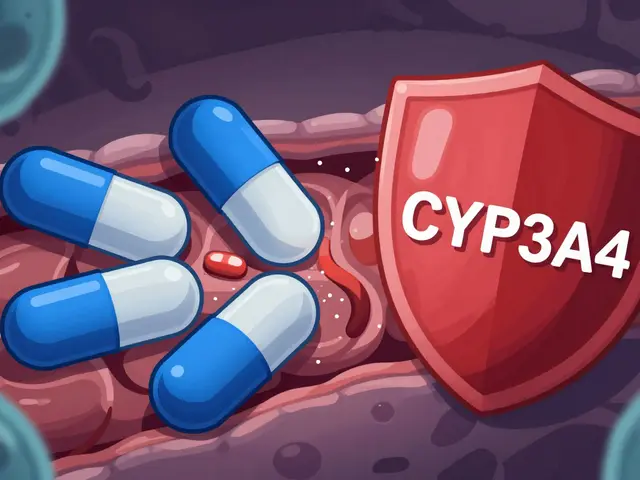
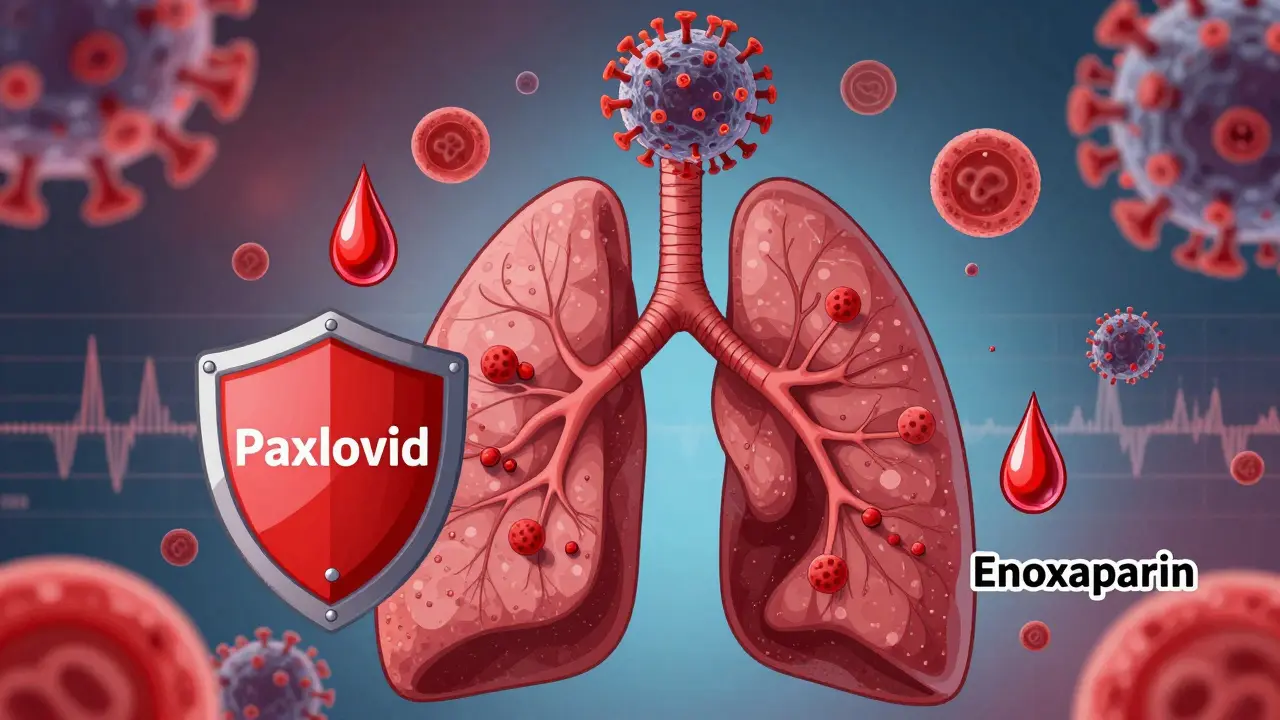
The problem doesn’t stop at the infection. Many of the drugs used to treat COVID-19 interfere directly with how blood thinners work. The biggest offender? Paxlovid (nirmatrelvir-ritonavir). Approved by the FDA in December 2021, it’s one of the most effective antiviral treatments for high-risk patients. But ritonavir, one of its two components, is a powerful inhibitor of CYP3A4 and P-glycoprotein-two key systems your body uses to break down and clear drugs. When these systems are blocked, blood thinners like apixaban, rivaroxaban, and dabigatran build up to dangerous levels in your bloodstream. A 2022 study in PMC9284020 tracked 12 patients on DOACs who got Paxlovid. All of them saw their anticoagulant levels spike by 3 to 5 times. One patient had a major gastrointestinal bleed. Another needed a blood transfusion. Meanwhile, dexamethasone-a steroid commonly used in severe cases-does the opposite. It speeds up the breakdown of DOACs, cutting their effectiveness by nearly half. So you could be getting too much of one drug one day, and too little the next, depending on what else you’re taking.DOACs vs. Warfarin: Different Risks, Different Rules
Not all blood thinners behave the same. Warfarin, the old-school anticoagulant, works by blocking vitamin K. It’s monitored with regular INR blood tests, which makes it easier to adjust. But even warfarin isn’t safe. A 2023 case study in Frontiers in Pharmacology showed a 70-year-old man’s INR jumped from 2.5 to 3.8 after taking azvudine (an antiviral) and dexamethasone together. That put him at high risk of bleeding. Still, warfarin’s predictable monitoring makes it somewhat easier to manage than DOACs. Direct Oral Anticoagulants (DOACs)-like apixaban (Eliquis), rivaroxaban (Xarelto), dabigatran (Pradaxa), and edoxaban (Savaysa)-don’t need routine blood tests. That’s convenient, but dangerous during a viral infection. They’re metabolized almost entirely by CYP3A4 and P-gp. That means they’re sitting ducks for drug interactions. The European Medicines Agency says to cut rivaroxaban’s dose in half if you’re on a strong CYP3A4 inhibitor. The U.S. FDA says just stop it entirely during Paxlovid treatment. There’s no global consensus. And that’s terrifying for patients and doctors alike.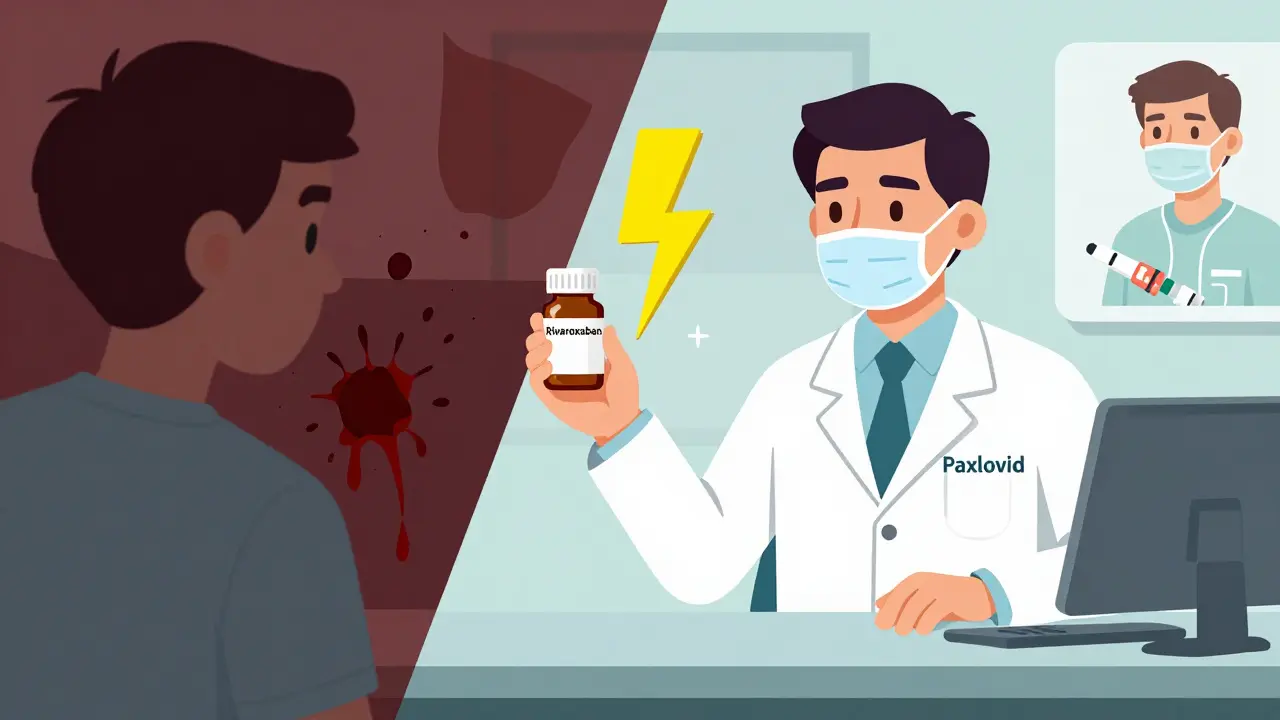
Real-World Chaos in Pharmacies and Hospitals
This isn’t just a textbook problem. It’s a daily emergency in clinics. A 2022 report from U.S. Pharmacist found that during the peak of the pandemic, time spent in the safe INR range dropped by 20% in anticoagulation clinics. Why? Fewer in-person visits, delayed lab work, and overwhelmed staff. At Mayo Clinic, anticoagulation-related ER visits jumped 37% in the first year of the pandemic. Nearly a third were directly tied to drug interactions. Community pharmacists saw it too. A survey by the American Pharmacists Association found that 63% of outpatient pharmacists dealt with at least one major anticoagulant interaction every month. Dabigatran and Paxlovid were the most common combo causing trouble. One Reddit user shared a harrowing story: a 68-year-old woman kept taking her full 15mg dose of rivaroxaban while on Paxlovid. She ended up in the ER with internal bleeding and needed two units of blood. Another case, shared by Dr. Sam Goldhaber on ASH Clinical News, showed a better outcome: switching from rivaroxaban to daily enoxaparin injections during the 5-day Paxlovid course, then restarting the DOAC afterward-with zero complications.How to Stay Safe: Practical Protocols
There’s no one-size-fits-all solution, but experts have built clear guidelines. The American Society of Health-System Pharmacists (ASHP) recommends this:- If you’re on apixaban or rivaroxaban and need Paxlovid: stop the DOAC for the full 5 days of treatment. Restart 2 days after the last Paxlovid dose. For patients at high risk of clots (like those with a CHA2DS2-VASc score ≥3), use low-molecular-weight heparin (like enoxaparin) as a bridge during those 5 days.
- If you’re on dabigatran and have normal kidney function (CrCl ≥50 mL/min): reduce the dose to 75 mg twice daily. Take it at least 12 hours before or after Paxlovid. Don’t take them together.
- If you’re on warfarin: keep taking it, but check your INR more often-ideally daily during Paxlovid treatment. Adjust the dose based on results.

What’s Changing-and What’s Next
The FDA issued a safety alert in July 2023 after reviewing 147 cases of major bleeding linked to DOACs and Paxlovid between January 2022 and June 2023. The NIH updated its guidelines in September 2023, now explicitly recommending therapeutic enoxaparin as a bridge for high-risk patients on DOACs during Paxlovid treatment. The good news? The next generation of antivirals is coming. Pfizer’s new drug, PF-07817883, currently in Phase 2 trials, shows almost no CYP3A4 inhibition. That means it won’t interfere with blood thinners. If it works, it could eliminate the biggest headache in anticoagulant management. Meanwhile, machine learning is stepping in. A 2023 study in Nature Medicine built an algorithm that predicts interaction severity with 89.4% accuracy using patient data like age, kidney function, and medication history. This isn’t science fiction-it’s already being tested in hospital systems.What You Need to Do Now
If you’re on a blood thinner and get diagnosed with COVID-19:- Don’t stop or change your dose without talking to your doctor or pharmacist.
- Always tell your provider exactly what medications you’re taking-including over-the-counter supplements.
- Ask: “Could this antiviral interact with my blood thinner?”
- Use the Liverpool website or similar tools to check interactions before starting any new drug.
- If you’re on a DOAC and prescribed Paxlovid, expect to switch temporarily to an injection like enoxaparin. It’s not ideal, but it’s safer.