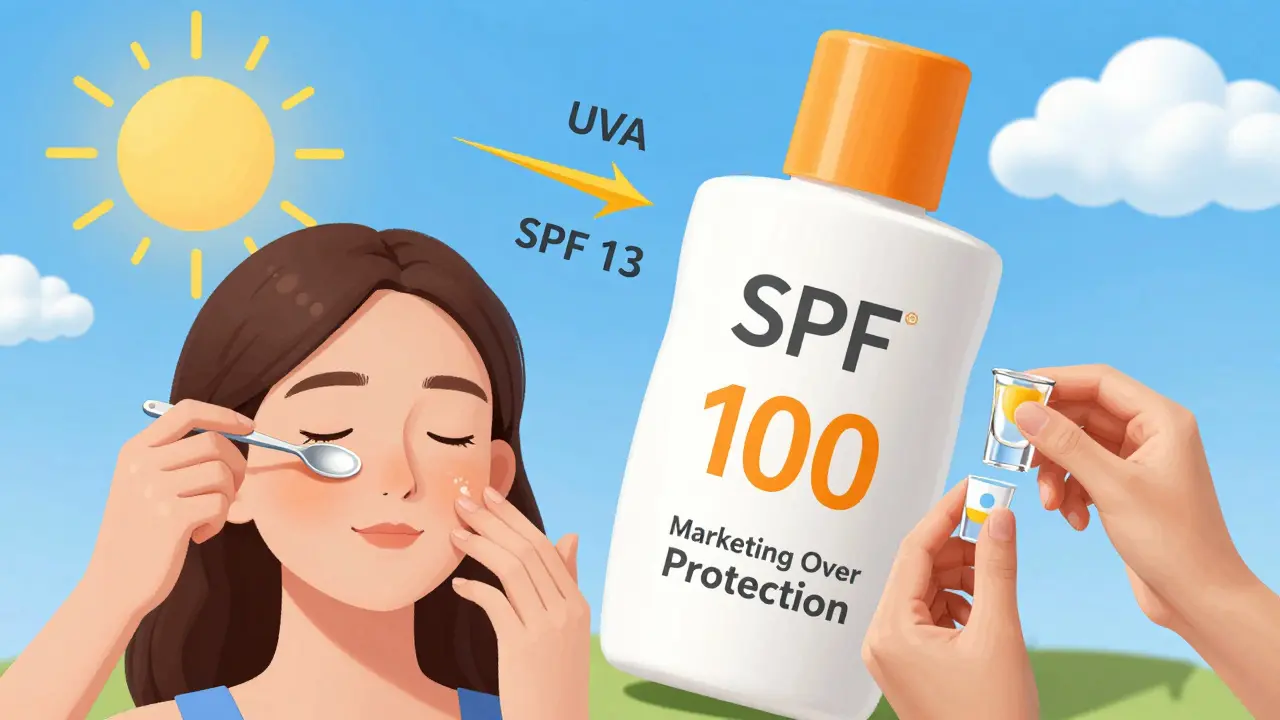


Most people think sunscreen is simple: slap it on, go outside, stay safe. But if your sunscreen is leaving a white cast, stinging your eyes, or you’re not sure if you’re using enough, you’re not alone. In fact, 72% of people skip reapplying sunscreen during beach days, even though they know they should. And here’s the scary part: many products on the shelf don’t even deliver the SPF they claim. In 2025, Consumer Reports found that some mineral sunscreens labeled SPF 50 only blocked UV rays like SPF 13. That’s not protection - that’s a gamble.
What SPF Really Means (And Why Higher Isn’t Always Better)
SPF stands for Sun Protection Factor. It measures how well a sunscreen blocks UVB rays - the ones that cause sunburn. SPF 30 blocks about 97% of UVB rays. SPF 50 blocks 98%. SPF 100 blocks 99%. That’s it. There’s no magic beyond SPF 50. The jump from SPF 30 to SPF 50 gives you just 1% more protection. But the price? It can double.The FDA says SPF 15 is the minimum for any sunscreen, but only if it’s not labeled as “broad spectrum.” If it claims to protect against both UVA and UVB, it must be at least SPF 30. That’s because UVA rays - the ones that sneak past clouds and windows - cause long-term skin damage, wrinkles, and skin cancer. UVB burns. UVA ages. Both kill.
So why do companies sell SPF 100? Marketing. It makes people feel safer. But if you’re not reapplying every two hours, SPF 100 is just a fancy number. A study in the Journal of the American Academy of Dermatology found that people using SPF 100 applied less than half the amount they used with SPF 30 - thinking they didn’t need as much. That’s how you end up with a bad burn.
Broad Spectrum Isn’t Just a Buzzword - It’s a Requirement
“Broad spectrum” means the sunscreen protects against both UVA and UVB. But not all broad spectrum sunscreens are created equal. The FDA requires a test called Critical Wavelength to prove a product covers UVA rays up to 370 nanometers. Anything below that doesn’t count.Here’s the problem: many mineral sunscreens - the kind with zinc oxide or titanium dioxide - struggle to meet this standard. In Consumer Reports’ 2025 testing, mineral sunscreens scored an average of 34.2 out of 100 for UVA protection. That’s barely better than no protection at all. Top performers like La Roche-Posay Anthelios Melt-in Milk SPF 60 scored 92/100. Why? Because they use advanced chemical filters like avobenzone, which is one of the most effective UVA blockers.
Mineral sunscreens aren’t bad. They’re great for sensitive skin, kids, or people with melasma. But if you’re trying to prevent skin cancer or premature aging, you need a formula that actually blocks UVA. Look for zinc oxide at 10% or higher - that’s the sweet spot for reliable mineral protection. Titanium dioxide alone? It’s not enough.
Chemical vs. Mineral: Which One Should You Use?
There are two main types of sunscreen: chemical and mineral.Chemical sunscreens absorb UV rays like a sponge. They contain ingredients like avobenzone, octinoxate, and oxybenzone. They go on clear, feel lightweight, and work quickly. But some ingredients can irritate eyes or cause allergic reactions. Oxybenzone is also linked to coral reef damage, which is why Hawaii and Key West banned it in 2021.
Mineral sunscreens sit on top of your skin and reflect UV rays. They use zinc oxide and/or titanium dioxide. They’re less likely to sting eyes or cause breakouts. But they often leave a white cast - especially on darker skin tones. And many don’t offer enough UVA protection unless they’re formulated with high concentrations of zinc oxide.
Here’s what dermatologists actually recommend:
- If you have acne-prone or sensitive skin: EltaMD UV Clear SPF 46 (9% zinc oxide + niacinamide)
- If you want maximum protection: La Roche-Posay Anthelios Melt-in Milk SPF 60
- If you’re at the beach or sweating: Neutrogena Ultra Sheer Dry-Touch SPF 100 (chemical, water-resistant for 80 minutes)
- If you’re worried about the environment: ThinkSport SPF 50+ (oxybenzone-free, reef-safe)
Price doesn’t always mean quality. CVS Health SPF 50 spray costs $2.99. JLo Beauty’s SPF 30 moisturizer costs $55. Both can work - if they’re applied correctly. The median price for a good sunscreen is $14.75 per ounce. Spend wisely, not extravagantly.
How Much Should You Actually Use? (Most People Use Too Little)
The FDA says you need 2 milligrams of sunscreen per square centimeter of skin. That’s about 1/4 teaspoon for your face. For your whole body? That’s roughly one ounce - the size of a shot glass.Most people use half that. And here’s the math: if you use half the amount, you’re only getting about one-third of the SPF protection. So SPF 30 becomes SPF 10. SPF 50 becomes SPF 17. You think you’re protected? You’re not.
Try this trick: squeeze out a line of sunscreen from the base of your pinky to your fingertip. That’s enough for your face and neck. For your arms and legs, use two full lines. If you’re using a spray, spray until your skin glistens - then rub it in. Sprays are easy to underapply.
Products like CeraVe and Supergoop! have videos showing exactly how much to use. Use them. Don’t guess.
Reapplication: The Most Ignored Rule
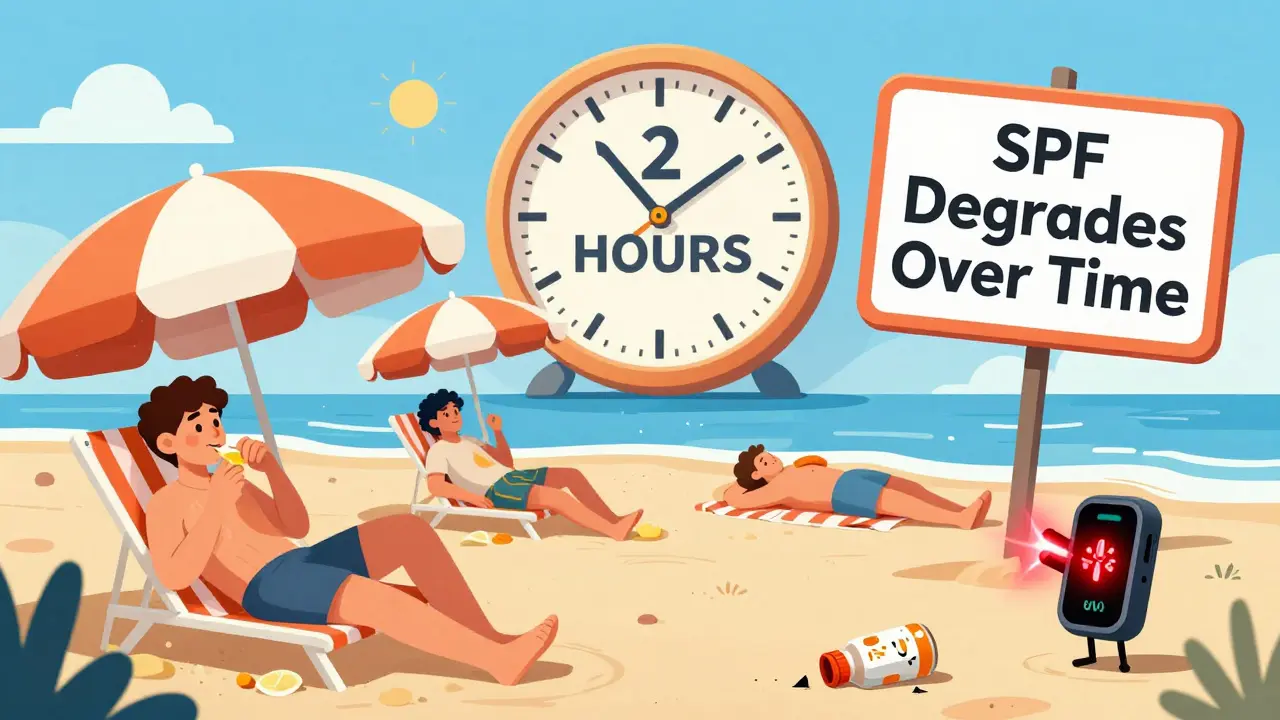
You’ve heard it a hundred times: reapply every two hours. But only 14.3% of beachgoers actually do it. Why? Because it’s inconvenient. You’re eating. You’re swimming. You’re having fun.But here’s the truth: sunscreen breaks down. Sweat, water, and towel-drying remove it. Even if you’re not sweating, UV rays degrade the active ingredients over time. That’s why the clock starts ticking the moment you apply it - not when you step outside.
Reapply after:
- 80 minutes of swimming or sweating
- Towel drying
- Every two hours, even if you’re under an umbrella
For daily use - like walking to work or sitting by a window - reapplying once around noon is enough. But if you’re outside for six hours? You need at least two applications. Keep a mini bottle in your bag. Or try a sunscreen stick for touch-ups on your nose and ears.
What to Avoid: The Common Mistakes
Here’s what actually fails in real life:- White cast on dark skin: Many mineral sunscreens oxidize or leave a grayish tint. Try Black Girl Sunscreen or Caravee Hydrating Sheer Sunscreen - both formulated for melanin-rich skin.
- Stinging eyes: Chemical sunscreens with oxybenzone or octinoxate can burn. Switch to a mineral formula or one labeled “for sensitive eyes.”
- Pilling under makeup: Wait 15 minutes after applying sunscreen before putting on foundation. Or use a sunscreen designed for makeup layering, like Supergoop! Unseen Sunscreen.
- Expired sunscreen: Most last three years. If it smells weird, changed color, or separated, toss it.
And never trust a product labeled “waterproof.” No sunscreen is waterproof. The FDA only allows “water resistant (40 minutes)” or “water resistant (80 minutes).” After that, reapply.
The Future of Sunscreen: What’s Changing in 2025
The FDA is finalizing new rules by the end of 2025. Here’s what’s coming:- Only SPF 30-50 will be allowed to be marketed - no more SPF 100+
- More chemical filters (like oxybenzone) may be banned unless proven safe
- All sunscreens must meet stricter UVA protection standards - matching EU rules
- UV-sensing wearables like Shade Smart will alert you when it’s time to reapply
Meanwhile, mineral sunscreens are growing fast. By 2027, they’ll make up 35% of the market. But until they match the UVA protection of top chemical sunscreens, they’re not the best choice for high-risk users.
One thing won’t change: sunscreen saves lives. The American Academy of Dermatology says daily use cuts melanoma risk by 50%. That’s not a guess. That’s science.
Final Checklist: Are You Using Sunscreen Right?
Before you head out, ask yourself:- Is my sunscreen SPF 30 or higher? (If not, ditch it.)
- Does it say “broad spectrum”? (If not, it’s not protecting you from aging or cancer.)
- Did I use a full teaspoon for my face? (No, you didn’t. Use more.)
- Did I reapply after swimming, sweating, or two hours? (If you’re unsure, reapply anyway.)
- Is it expired or weird-looking? (If yes, throw it away.)
Don’t wait for a sunburn to change your habits. Sun damage adds up - silently, over years. The skin cancer you prevent today might be the one you never get tomorrow.
Is SPF 50 better than SPF 30?
SPF 50 blocks 98% of UVB rays; SPF 30 blocks 97%. That’s only a 1% difference. But people using SPF 50 often apply less, thinking they’re fully protected. In reality, both need to be reapplied every two hours. SPF 30 is sufficient for most people if used correctly.
Do I need sunscreen on cloudy days?
Yes. Up to 80% of UV rays penetrate clouds. UVA rays - the ones that cause aging and skin cancer - are especially strong on overcast days. Daily sunscreen use is the best way to prevent long-term damage, regardless of the weather.
Can I use last year’s sunscreen?
Most sunscreens last three years if stored properly. Check the expiration date. If it’s separated, smells off, or changed texture, throw it out. Expired sunscreen won’t protect you - even if the bottle says SPF 50.
Are mineral sunscreens safer for the environment?
Mineral sunscreens with zinc oxide or titanium dioxide are generally reef-safe. Chemical filters like oxybenzone and octinoxate are banned in Hawaii and other coral reef areas because they damage marine life. If you’re swimming in oceans, choose a product labeled “reef-safe” and avoid oxybenzone.
Why does my sunscreen pill under makeup?
Pilling happens when sunscreen doesn’t fully absorb before makeup is applied. Wait 15 minutes after applying sunscreen before putting on foundation. Use a lightweight, non-greasy formula designed for makeup wear, like Supergoop! Unseen Sunscreen or Caravee Hydrating Sheer Sunscreen.
Don’t overthink it. Just use enough. Reapply often. Choose broad spectrum. Your skin will thank you - decades from now.




15 Comments
SPF 100 is just a scam. I used to buy it until I read the fine print. You’re literally paying for a placebo.
Use SPF 30, apply like you mean it, and stop wasting money.
The FDA’s new rules are long overdue. America’s sunscreen industry has been running a con for decades.
Meanwhile, Europe has had real UVA standards since 2010. We’re still playing catch-up because corporations control the regs.
And don’t get me started on ‘mineral’ sunscreens made for melanin-rich skin - half of them are just marketing with zinc dust.
Real protection isn’t about branding. It’s about chemistry. Avobenzone works. Zinc oxide at 10%+ works. Everything else is noise.
SPF 100 is for people who think more numbers = more safety. Bro, you’re not a superhero. You’re just lazy.
I use Neutrogena Dry-Touch. I reapply every two hours like a grown-up. I don’t need a $55 moisturizer with ‘JLo’ on it.
And if your sunscreen stings your eyes? You’re using the wrong one. Switch to mineral. Or better yet - wear a hat.
Also, no, your ‘waterproof’ sunscreen isn’t waterproof. It’s ‘water resistant’ - and only for 80 minutes. Read the label. It’s not that hard.
I just wanted to add - if you have acne-prone skin, try Vanicream SPF 50. It’s fragrance-free, non-comedogenic, and doesn’t pill under makeup. I’ve been using it for 2 years and haven’t broken out once.
Also, the ‘shot glass’ rule for body? Yes. I used to wing it until I started measuring. Now I know I was only getting SPF 10-15 with my ‘SPF 50’.
And expired sunscreen? I throw mine out after 18 months. Even if it hasn’t expired, heat from the car or beach bag degrades it fast.
As someone from Kenya who grew up under the equator, I can tell you - sunscreen isn’t a luxury. It’s survival.
My grandma never used it. She’s 82 and has skin like leather. But she also never left the house without a headwrap and long sleeves.
Here in the US, I see people slathering on SPF 50 then spending 6 hours at the beach without reapplying. It’s not about the number - it’s about behavior.
Also, Black Girl Sunscreen? Game changer. My cousin used to hate sunscreen until she tried it. No white cast. No grease. Just protection.
And yes, clouds? Still dangerous. I’ve seen people get burned on overcast days. UVA doesn’t care if it’s raining.
SPF 100 is for people who think they’re bulletproof
And yes I’m talking to you
Also no your ‘reef safe’ sunscreen isn’t saving the oceans if you’re still using 3 tubes a week
Just stay inside
I used to think mineral sunscreens were the answer until I tried one and looked like a ghost.
Then I found EltaMD UV Clear - no white cast, no breakouts, and it doesn’t sting my eyes.
Also, reapplying every two hours? I keep a mini bottle in my purse and a stick in my car.
My dermatologist says daily use cuts melanoma risk by half - and I believe her.
Don’t wait for a mole to change.
Protect now.
Thank you for this post 💪🌞
It is imperative to note that the efficacy of topical photoprotection is contingent upon the volume of application.
Two milligrams per square centimeter is the standard.
Failure to adhere to this standard renders SPF claims statistically irrelevant.
Furthermore, photodegradation occurs within two hours regardless of activity level.
Reapplication is not optional.
It is a biological necessity.
While the article is commendable in its intent, it fails to address the systemic commodification of dermatological care.
SPF marketing is a grotesque parody of preventative medicine.
One cannot reduce skin cancer prevention to a retail transaction.
The true solution lies in cultural re-education - not in purchasing another $55 jar of ‘luxury’ sunscreen.
And yet, we are sold the illusion of control through product choice.
How tragic.
Love this breakdown! 🙌
As an Indian guy who grew up with ‘talcum powder as sunscreen’ - I didn’t know any better until I moved to the US.
Now I use ThinkSport SPF 50 - reef-safe, no white cast, and my skin doesn’t feel like a greasy mess.
Also, reapplying after swimming? I set a phone alarm. It’s that important.
And yes - SPF 30 is enough if you use enough. No need to break the bank.
Thanks for the real talk 🌞🙏
The critical wavelength metric is underutilized in consumer education. Most users equate broad spectrum with UVA protection - but the FDA’s threshold (370nm) is minimal.
Top-tier products like La Roche-Posay exceed this with avobenzone-stabilized systems.
Mineral formulations without zinc oxide >10% are functionally inert against UVA.
It’s not marketing - it’s physics.
SPF 100 is just Big Pharma’s way of keeping us hooked.
And ‘mineral’ sunscreens? They’re made by companies who know black people exist but don’t care enough to fix the white cast.
Also - why do they still sell sprays? You can’t even measure it. You’re just spraying air and hoping.
And don’t even get me started on ‘JLo Beauty’.
She’s not a dermatologist. She’s a singer who sells moisturizer.
Wake up.
They’re lying to you. 😒
Okay but have you heard about the sunscreen cartel? Like, seriously. The FDA lets them label SPF 100 because they’re scared of lawsuits.
And the ‘reef-safe’ labels? Totally fake. I read a whistleblower blog that said the testing labs are owned by the same companies that make the sunscreen.
And why is there no regulation on the ‘invisible’ chemical filters? They’re getting into our bloodstreams and no one talks about it.
Also - I think the white cast on dark skin is intentional. So we keep buying ‘special’ versions and paying more.
And don’t get me started on the fact that sunscreen companies sponsor dermatology conferences.
It’s all a lie. We’re being manipulated. And you’re all just buying it.
Just stay inside. Or wear a hat. Or both. But don’t trust the bottle.
They’re selling fear. And they’re making billions.
And you’re the product.
Just saying.
👁️👁️👁️
The question of sunscreen is not merely about chemistry or marketing - it is a reflection of our relationship with nature and mortality.
We seek control over the sun, an elemental force that has sustained life for billions of years, yet we fear its gentle rays as if they were a personal enemy.
Is it not paradoxical that we cover ourselves in synthetic compounds to avoid a natural phenomenon - while simultaneously destroying the very atmosphere that once shielded us?
Perhaps the real solution lies not in higher SPF or better formulations, but in relearning humility - in walking in shade, in dressing with intention, in living within limits.
Still, I do not dismiss the value of protection.
Let us use sunscreen - not as a shield against nature, but as an act of care for the fragile vessel that carries us through this life.
And let us apply it with mindfulness - not because we are told to, but because we choose to honor our bodies.
Thank you for this thoughtful post. It invites not just compliance, but contemplation.
Someone above said ‘just stay inside’ - yeah, right. I work outside. I have a kid. I live here.
So I’ll keep using SPF 30, reapplying, and not falling for the $55 nonsense.
Thanks for the reminder, everyone.