
Every household in New Zealand has medicines - from your daily blood pressure pill to your child’s cough syrup. But where you keep them could be putting lives at risk. Medication storage isn’t just about keeping things tidy. It’s about stopping a child from swallowing a whole bottle of pills, preventing a teenager from experimenting with painkillers, or protecting an elderly parent from taking the wrong dose. And it’s not as simple as putting things on a high shelf.
Why Your Bathroom Cabinet Is the Worst Place for Medicines
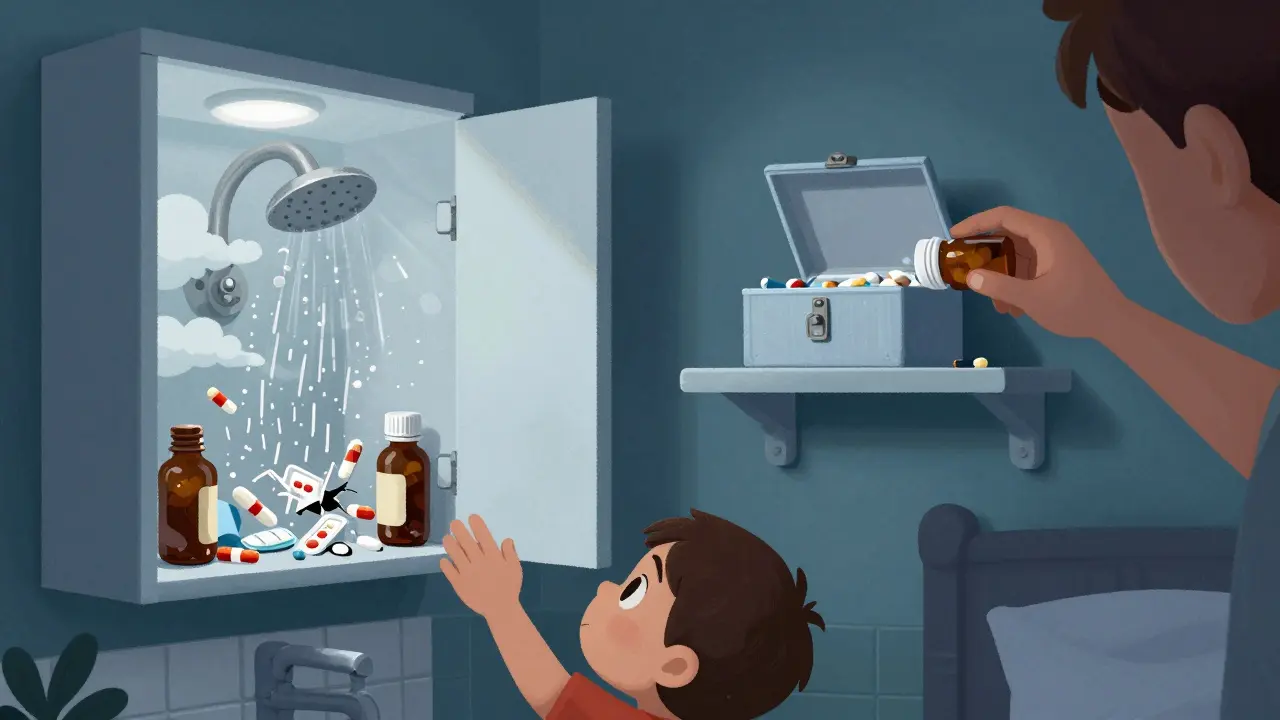
You’ve probably seen it: the medicine cabinet above the sink, filled with antibiotics, painkillers, and antihistamines. It looks convenient, right? But humidity from showers and baths can wreck your meds. According to MedlinePlus, 67% of common medications degrade within 30 days when stored in bathrooms with humidity over 80%. That means your insulin might not work. Your antidepressants could lose potency. Your asthma inhaler might sputter when you need it most. And it’s not just about effectiveness. Bathrooms are easy for kids to reach. Even if the cabinet is locked, many aren’t child-resistant enough. A 2023 study from Washington State found that 73% of accidental poisonings happened because medicines were left in unlocked cabinets, on countertops, or in purses. The bathroom? That’s where most people keep them.The Gold Standard: Locked, Cool, and Dry
The safest place for your medicines is a locked box, in a cool, dry spot. Not the kitchen. Not the car. Not the bedside table. A locked cabinet or drawer - ideally one that’s out of sight and out of reach - is the minimum standard. The EPA and FDA both agree: if it’s not locked, it’s not safe. Temperature matters too. Most pills should be kept between 68°F and 77°F (20°C-25°C). That’s room temperature in most homes. Avoid windowsills, garages, or near the oven. Heat and sunlight break down active ingredients. Insulin, liquid antibiotics, and some heart medications need refrigeration. But don’t store them in the fridge door - the temperature swings there can ruin them. Put them in the back, on a middle shelf, and keep them in a sealed container so they don’t pick up food odors.Locks, Safes, and Smart Solutions
You don’t need a fancy safe. A simple lockable medicine box costs as little as $20. Some even come with keys or combination locks. If you have a gun safe, fireproof document box, or locked filing cabinet - use it. In rural areas, 18% of households already do. That’s not just for guns. It’s for pills too. Newer options include digital dispensers with biometric locks. These devices only open for authorized users, track when someone takes a dose, and can even send alerts if a dose is missed. A 2022 University of Michigan report found they’re 78% effective at stopping unauthorized access. They’re pricier - up to $150 - but worth it if you have someone with dementia or a history of substance misuse in the home.What to Do After You Take a Pill
Here’s a mistake most people make: they leave the bottle out after giving a dose. That five-minute window - when the cap’s off, the pills are on the counter, and the spoon’s still in hand - is when 42% of child poisonings happen. That’s according to the National Association for Children of Alcoholics’ 2025 Parent’s Guide. Make it a habit: as soon as you finish, put it back. No exceptions. Even if you’re tired. Even if you’re in a rush. Even if you’re alone. That bottle belongs in the locked box. Always.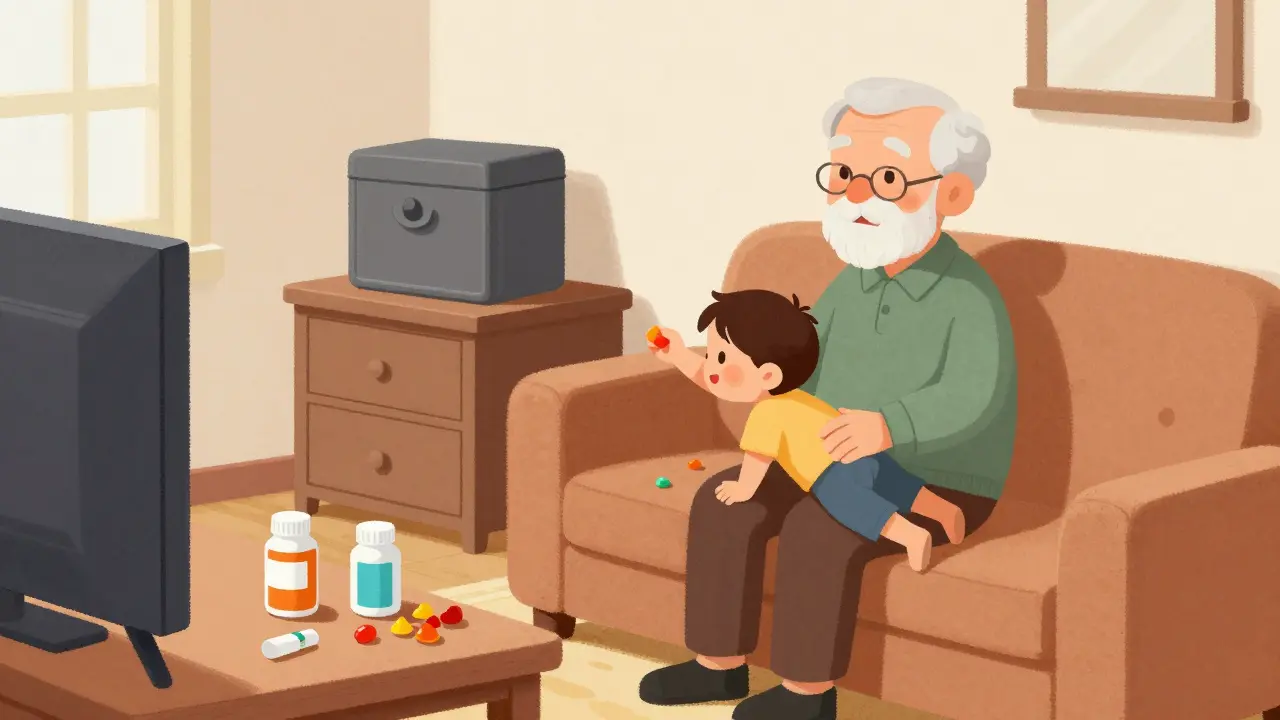
What About Grandparents’ Homes?
One in every two accidental poisonings involving children happens in a grandparent’s house. Why? Because grandparents often don’t realize how dangerous their medicine cabinet is. They might think, “I’m just keeping it on the counter so I can remember to take it.” But kids visit. Grandkids climb. And they don’t know the difference between candy and pills. If you’re a grandparent, or you visit one, ask: “Where do you keep your meds?” If the answer is “on the nightstand” or “in the drawer by the TV,” it’s time to change that. Bring a small lockbox with you. Or help them find one. It’s not about control. It’s about care.Don’t Fall for These Myths
Myth: “High shelves are enough.” Kids as young as 24 months can climb to reach 48-inch shelves. A 2023 Washington State report showed 48% of children under 3 could access meds stored this way. Myth: “Child-resistant caps protect everything.” They help - but they’re not foolproof. Half of all 5-year-olds can open them. That’s not a feature. That’s a failure. Myth: “I only keep a few pills. It’s not a big deal.” Even one pill can be deadly to a child. A single dose of fentanyl - sometimes found in leftover painkillers - can kill a toddler. And over-the-counter drugs like acetaminophen can cause liver failure if too many are taken.What to Do with Old or Expired Medicines
Don’t flush them. Don’t throw them in the trash. Don’t pour them down the sink. These methods pollute waterways and can still be accessed by animals or people. Instead, find a take-back program. In New Zealand, pharmacies like Countdown, Priceline, and HealthPost offer free medicine disposal bins. You can drop off old antibiotics, unused painkillers, or expired vitamins. No questions asked. Some local councils also hold annual collection days. If no take-back option is nearby, mix pills with something unappetizing - coffee grounds, cat litter, or dirt - put them in a sealed bag, and throw them in the trash. Remove labels or scratch out personal info to protect your privacy.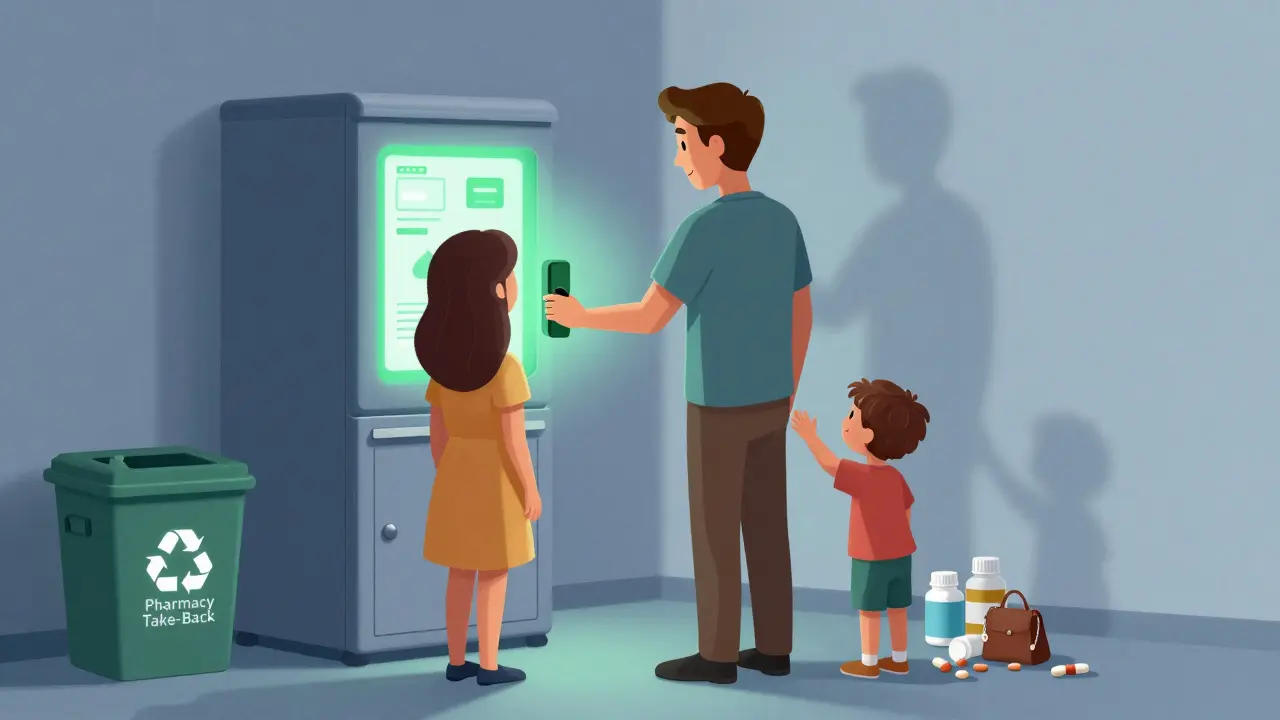
Special Cases: Insulin, Opioids, and Mental Health Meds
Insulin needs to be refrigerated until opened. Once opened, it can last 28 days at room temperature - but still needs to be locked up. Store it away from food, in a labeled container. Opioids like oxycodone or codeine are especially dangerous. The EPA partnered with 7,200 pharmacies in 2023 to give free lockable containers with every opioid prescription. Use it. If you’re not using it anymore, drop it off at a pharmacy. Don’t keep it “just in case.” Antidepressants and anxiety meds can be lethal in overdose. Keep them locked. Even if the person taking them is an adult. Accidental overdoses happen when someone grabs the wrong bottle in the dark.How to Talk to Your Family About This
This isn’t about distrust. It’s about safety. Say it plainly: “I love you, and I don’t want anyone to get hurt by accident.” Show them the numbers. Tell them that 60,000 kids end up in emergency rooms every year in the U.S. alone - just from grabbing pills. Most of those cases are preventable. Make it part of your household routine. Like locking the door or turning off the stove. Put the medicine box in the same spot every day. Everyone knows where it is. Everyone knows it’s locked. No one has to ask.Final Check: Is Your Storage Safe?
Ask yourself these five questions:- Are all medicines - prescription, OTC, vitamins - kept in a locked container?
- Is the container stored away from heat, moisture, and direct sunlight?
- Are child-resistant caps on all bottles, even if you think the child can’t reach them?
- Are expired or unused meds taken to a pharmacy for disposal?
- Do all adults in the home know where the meds are stored - and that they must be returned after use?
Can I store my medications in the kitchen?
Only if the kitchen is cool and dry - and you have a locked cabinet. Most kitchens are too warm near the stove or too humid near the sink. Avoid storing medicines above the fridge or near the dishwasher. A locked cupboard away from cooking areas is okay, but a bedroom drawer or closet is safer.
What if I have a child with special needs who needs quick access to meds?
In cases like epilepsy or severe allergies, some children need fast access to rescue meds like epinephrine or anti-seizure drugs. Work with your doctor to create a plan. Keep the emergency dose in a clearly labeled, easy-to-reach location - but still locked if possible. Use a lockbox with a quick-release mechanism, or store it in a bedside drawer with a simple lock that only caregivers can open. Always have a backup dose in your car or bag if you’re out.
Is it safe to keep medications in my purse or coat pocket?
No. Purses and coat pockets are the second most common source of accidental poisonings in children, after unlocked cabinets. Temperature swings, moisture, and being left on the floor or in a car make pills less effective - and easy for kids to find. If you need to carry meds, use a small locked case and return it to your safe storage spot as soon as you get home.
Do I need to keep all vitamins and supplements locked up?
Yes. Many people think vitamins are harmless. But iron supplements can be deadly to children. High doses of vitamin D or calcium can cause poisoning. Even gummy vitamins look like candy. Treat them the same as prescription drugs: lock them up. The same rules apply.
What should I do if my child swallows a pill?
Call your local poison control center immediately. In New Zealand, dial 0800 764 766 (Poison Control). Don’t wait for symptoms. Don’t try to make them vomit. Have the pill bottle ready - they’ll need the name, dose, and time taken. Keep the bottle even if it’s empty. Every second counts.

15 Comments
The pharmacokinetic instability of pharmaceuticals under ambient humidity conditions is a clinically significant yet systematically overlooked public health variable. The degradation pathways of peptide-based biologics like insulin, for instance, involve non-enzymatic deamidation and oxidation mechanisms that are exponentially accelerated above 80% relative humidity. This isn't mere anecdotal concern-it's a thermodynamic inevitability grounded in Arrhenius kinetics. The bathroom cabinet, as a microenvironment, functions as a catalytic chamber for molecular decomposition. We're not just talking about reduced efficacy; we're talking about subtherapeutic dosing that can trigger iatrogenic exacerbations in chronic conditions. The data from MedlinePlus isn't suggestive-it's a warning label written in biochemistry.
Okay but can we just take a second to celebrate how amazing it is that we’re finally talking about this? Like, I used to leave my mom’s blood pressure pills on the counter because she ‘forgot’ where she put them-now I’ve got this little lockbox on the top shelf of her closet and she actually says she feels safer. It’s not about control, it’s about love. And honestly? If we can make this a normal part of home safety like smoke detectors or childproof locks, we’re gonna save so many lives. Even just one person putting their meds away after taking them? That’s a win. Let’s keep spreading this vibe 💪
I used to think the bathroom cabinet was fine until my niece got into my ex’s anxiety meds and ended up in the ER. That was a wake-up call. Now everything-vitamins, supplements, even the gummy ones-is in a locked box under the sink in the laundry room. No heat, no steam, no temptation. And I tell every friend I know to do the same. It’s not paranoia. It’s just smart. Kids are curious. They’re not evil. They’re just small humans who don’t know what’s safe. So we do the work for them. Easy fix. Big impact.
Stop pretending this is a safety issue. This is control culture dressed up in medical jargon. You think locking up medicine stops abuse? It just drives it underground. People who want to misuse pills will find them. The real problem is the pharmaceutical industry pushing addictive drugs and then acting shocked when people get hooked. Your ‘locked box’ is a Band-Aid on a bullet wound. And your ‘child-resistant caps’? They’re designed to fail so you keep buying more. Wake up.
Locking medications is non-negotiable. The statistics are unequivocal. The CDC reports over 60,000 pediatric exposures annually in the U.S. alone. Most are preventable. The solution is simple: secure storage, proper disposal, and consistent habit formation. No exceptions. No compromises. This is public health 101. If you are not securing your medications, you are not fulfilling your duty of care. Period.
Thank you for writing this. I’m a nurse and I see the aftermath of poor medication storage every week. One time, a 4-year-old swallowed an entire bottle of melatonin gummies-thought they were candy. He was fine, but it took three hours of monitoring and a ton of stress. Parents don’t realize how dangerous even ‘harmless’ supplements are. I give every family I work with a small lockbox. It costs less than a coffee. But it saves lives. Please, if you read one thing today-lock your meds.
LOL you people are hilarious. You’re treating medicine like it’s plutonium. Next you’ll be locking up aspirin because ‘a single pill can kill a toddler.’ Sure, if the toddler is 10 lbs and the pill is fentanyl. But for 99% of people, this is fearmongering. Kids don’t eat random pills. They eat LEGOs. And if they do grab something? Call poison control. Done. Your ‘locked box’ is just a status symbol for anxious parents. Chill out. The world isn’t ending because someone left a bottle on the counter.
This is such a good guide. I live in India and we don’t have proper disposal systems, so I’ve been mixing old pills with coffee grounds and burying them in the garden. It’s not ideal, but it’s better than flushing. I also bought a small lockbox for my grandmother’s diabetes meds-she used to keep them on the windowsill. Now she calls it her ‘medicine safe.’ She’s proud of it. Small changes, big difference. We need more of this awareness in developing countries too.
One thing the article doesn’t mention: what about pets? Dogs and cats will eat anything. I had a dog who got into my antidepressants. She was fine, but the vet bill was $800. Now everything’s locked-even the fish tank meds. If you have animals, treat meds like they’re toxic. Because they are.
Did you know the FDA is secretly pushing this ‘locked box’ agenda to control the population? They want you dependent on their ‘safe’ systems so they can track your medication use through smart dispensers. The real danger isn’t your kid-it’s the surveillance state. They’re using ‘child safety’ as a cover to implant tracking chips in pill bottles. I’ve seen the documents. Don’t buy into it. Use a Mason jar. Free your meds.
I just started doing this last month and honestly? It’s changed my whole family’s vibe. No more midnight pill searches. No more ‘did I take mine?’ stress. We have one spot-a little black box on the top shelf-and everyone knows it. Even my 8-year-old knows not to touch it. It’s not scary, it’s just routine. Like brushing teeth. I wish I’d done this years ago. So simple. So powerful.
Wow. 1500 words about locking up pills. Did you get paid by LockBox Inc? Or is this just your way of pretending you’re a responsible adult? I leave my meds on the nightstand. I’m an adult. I can handle it. Your ‘statistics’ are just fear porn. Also, you spelled ‘pharmacy’ wrong in the third paragraph. 😴
I’ve been a caregiver for my mom with dementia for 7 years, and let me tell you-this isn’t theoretical. I’ve watched her take her blood pressure meds twice in one day because she forgot she already did. I’ve found half-eaten pills under the couch. I’ve had to explain why she can’t take her neighbor’s pills ‘because they look similar.’ The smart dispenser I got? Worth every penny. It beeps, it logs, it texts me if she misses a dose. And yes, it locks. But more than that-it gives her dignity. She doesn’t feel like a prisoner. She feels like she’s still in control. That’s the real win here.
This is pure Western paranoia. In India, we keep medicines on open shelves because we trust our children. We teach them respect, not fear. Why lock up what should be shared knowledge? Your obsession with containment reveals a deeper cultural sickness-you don’t trust your own families. We raise kids who know the difference between food and medicine because we talk to them, not because we hide things behind locks. This article is colonial thinking dressed as safety.
Locking medications is a basic ethical obligation. Failure to do so constitutes negligence. The burden of proof lies with the caregiver. If a child is harmed due to accessible pharmaceuticals, the legal and moral responsibility rests entirely with the adult in charge. There is no justification for lax storage. Not convenience. Not tradition. Not cultural norms. This is non-negotiable.